Sunday, April 29, 2012

Book 2 of the Curse of the Lost Isle is out! by Vijaya Schartz

CURSE OF THE LOST ISLE SERIES:
From history shrouded in myths, emerges a family of immortal Celtic Ladies, who roam the medieval world in search of salvation from a curse. For centuries, imbued with hereditary gifts, they hide their deadly secret... but if the Church ever suspects what they really are, they will be hunted, tortured, and burned at the stake.

Find the two books in kindle HERE

810 AD - Alba (Ancient Scotland) - Queen at last, Pressine brings victory to her beloved Elinas and prosperity to their growing kingdom. But she has to contend with the intrigues of Charlemagne's bishops, spurred by her Christian stepson. While Elinas, on the battlefield, remains unaware of his son’s machinations, Pressine fends off repeated assaults against her life. She also fears the curse that could bring her downfall. For the love of Elinas, she will tempt fate and become with child. But when her indomitable passion challenges the wrath of the Goddess Herself... can she win that battle?
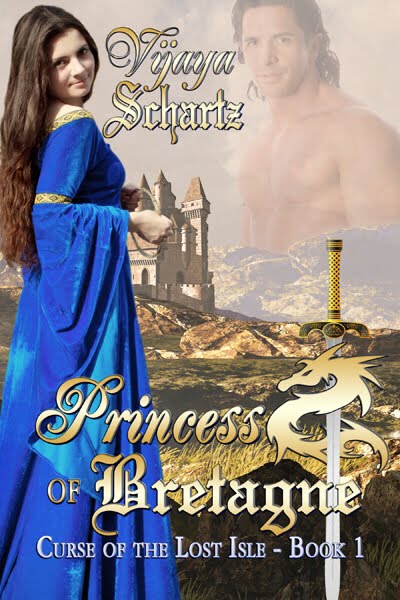
PRINCESS OF BRETAGNE:806 AD - Alba (Ancient Scotland) - As the Vikings raid the coast of Alba, Pressine of Bretagne sets out to seduce King Elinas of Dumfries, chosen by the Goddess to unite the tribes against the foreign invader. Elinas, still mourning his departed queen, has no intention to remarry. Head-strong and independent, Pressine does not expect to fall for the very attractive, wise and noble ruler... Furthermore, her Pagan nature clashes with the religious fanaticism of the king’s Christian heir, who suspects her unholy ancestry and will stop at nothing to get rid of her.

Many other books will follow, but these two books are companions and feature the same main characters.

Hope you are enjoying this series.

Vijaya Schartz
Swords, Romance with a Kick
http://www.vijayaschartz.com/

 PAGAN QUEEN:

Thursday, April 26, 2012

What the heck is BRETAGNE? - by Vijaya Schartz

What the heck is Bretagne? So many readers asked me this question that I have to answer it.

Bretagne is a French province, a rocky peninsula at the extreme west point of France (not Britain), and is sometimes called Brittany. Its inhabitants are called Bretons. Sounds familiar? During the Roman invasions and into the dark ages it was an independent kingdom called Armorica, and the old religion was Druid. There you’ll find many stone circles and alignments (Menhir and Cromlechs). Bretagne has undeniable Celtic roots and still remembers dialects akin to the old Celtic languages of Ireland, Cornwall, and Wales. The Bretons have been sailors and fishermen from the start and frequently crossed the English Channel, even in ancient days.

If you travel there, you can visit the magic forest of Broceliande, domain of the great sorcerer Merlin. You can even visit Merlin’s grave... a modest Druid site with sticks and stones. A few miles away, at the cafĂ© by the lake (yes, that lake), a sword set in a stone was later added for the benefit of modern tourists who love to take pictures of such gaudy things. According to the local folklore, Lancelot was born in Broceliande, so were Merlin and Vivian the Fae. From there surged many Arthurian and post Arthurian legends all through the Middle Ages.

By 806 AD, Bretagne was an important kingdom under king Salomon, who had just sworn allegiance to the Emperor Charlemagne. Lady Pressine, the heroine of Princess of Bretagne and Pagan Queen, was an illicit daughter of King Solomon of Bretagne, born from a Lady Fae of Broceliande...

Mystery solved. Now you know all about Bretagne, and you can impress your friends at dinner. And if you want to know what happened to Pressine, read Princess of Bretagne and Pagan Queen.

But first, here is what the CURSE OF THE LOST ISLE series is about:

From history shrouded in myths, emerges a family of immortal Celtic Ladies, who roam the medieval world in search of salvation from a curse. For centuries, imbued with hereditary gifts, they hide their deadly secret, stirring passions in their wake as they fight the Viking hordes, send the first knights to the Holy Land, give birth to kings and emperors... but if the Church ever suspects what they really are, they will be hunted, tortured, and burned at the stake.
PRINCESS OF BRETAGNE:
March 2012 release
Find it on Amazon HERE

806 AD - Alba (Ancient Scotland) - As the Vikings raid the coast of Alba, Pressine of Bretagne sets out to seduce King Elinas of Dumfries, chosen by the Goddess to unite the tribes against the foreign invader. Elinas, still mourning his departed queen, has no intention to remarry. Head-strong and independent, Pressine does not expect to fall for the very attractive, wise and noble ruler... Furthermore, her Pagan nature clashes with the religious fanaticism of the king’s Christian heir, who suspects her unholy ancestry and will stop at nothing to get rid of her. As the Vikings raid the coast of Alba, Pressine of Bretagne sets out to seduce King Elinas of Dumfries, chosen by the Goddess to unite the tribes against the foreign invader. Elinas, still mourning his departed queen, has no intention to remarry. Head-strong and independent, Pressine does not expect to fall for the very attractive, wise and noble ruler... Furthermore, her Pagan nature clashes with the religious fanaticism of the king’s Christian heir, who suspects her unholy ancestry and will stop at nothing to get rid of her.

Have a wonderful day.
Vijaya Schartz
Swords, Romance with a Kick


PAGAN QUEEN: May 2012 release

810 AD - Alba (Ancient Scotland) - Queen at last, Pressine brings victory to her beloved Elinas and prosperity to their growing kingdom. But she has to contend with the intrigues of Charlemagne's bishops, spurred by her Christian stepson. While Elinas, on the battlefield, remains unaware of his son’s machinations, Pressine fends off repeated assaults against her life. She also fears the curse that could bring her downfall. For the love of Elinas, she will tempt fate and become with child. But when her indomitable passion challenges the wrath of the Goddess Herself... can she win that battle?

Saturday, April 21, 2012

Why Medieval authors write Science Fiction novels - by Vijaya Schartz

As an author, I write romance in futuristic and medieval settings, and sometimes, I mix both into the same series, like in the Chronicles of Kassouk, where I pit a medieval society against an advanced technological race. And contrary to modern logic, medieval humans are smart, very resourceful and full of surprises... enough to outdo their betters. Everyone enjoys seeing the oppressed win in the end.

A number of new authors are now also writing medieval as well as science fiction novels, but this is not a new phenomenon. Marion Zimmer Bradley in the eighties and nineties wrote in both science fiction and medieval genres with her Mists of Avalon (Arthurian legends) series and her Darkover (speculative fiction) series, and she met with great success in both genres. Most of her readers did cross over the genres to read all her books.

Writing the past or the future is not so far apart. Research is still research. For the future, instead of researching historical facts, you research modern science in order to project where the next logical evolutionary step will lead, and what kind of future society it will likely engender. Creating an unfamiliar world and making it real to the reader, whether in the past or in the future, requires the same skills, the same kind of imagination that projects into a world with different sets of rules, a different political climate, different dress codes, eating habits, different laws and ethics, different religious beliefs, different taboos, etc.

The only thing that doesn’t change through the ages is people. Although we would like to believe that we evolved over the last millennia, we really haven’t. Despite our fancy laws, we still have serial killers and terrorists. Given the opportunity, any human being will behave in the same noble or despicable manner now as he or she would have centuries ago. And in the future, it will probably still be the case. Of course, in the future there also might be robots, cyborgs, and clones which might operate under a different set of rules. But is that so different from the rules controlling the slaves of ancient times?

The struggle for justice, however, like the need for love and freedom, are timeless and constant themes that keep repeating in the past, the present, and will most likely endure in the future. Because these needs are inherent to human nature.

In conclusion, whether a writer tackles the past or the future, what carries a story, beyond the action, adventure and plot, is human emotion. So I hope you'll give a try to my other novels, especially the Chronicles of Kassouk, where I created a medieval world for your reading pleasure.

Vijaya Schartz
Swords, Romance with a Kick
Find all my books on Amazon at:

Thursday, April 19, 2012

How did people communicate over long distance in the middle ages?

If you want instant and painless access to my ebook Unbidden, it is FREE on Amazon Thursday and Friday, April 19 and 20.

Instant Access - I don't know about you but many people expect that I should be available for communication all the time.  As in NOW!  My husband will call two phone numbers and text me within minutes trying to track me down.  His customers will call him nights and weekends, and some are offended that he does not answer business calls during those times.  Everyone wants us and the fascinating information from our brains NOW!

I am old enough to remember when phones were attached to wall jacks and mail came on paper so sympathizing  and understanding the limitations in communication in the historical romances I read and write might be less of a stretch than it is for the younger generation.  Nonetheless, it is something that has to be considered when creating a timeline and plot, and can be used to enrich the story.

How did people communicate over long distance?  How reliable was it?  (We have all read stories in which the disappearance of a single letter changed the course of a relationship.  Or worse, when the wrong person reads the letter....)  How could a young heroine survive for months without any word from the man she adored from afar?  Poor Elizabeth Bennett could not even send Darcy a text saying "Sorry dude <3" after he revealed his life history to her in a long hand-written letter.  Yet somehow Jane Austen makes us continue to care what Elizabeth is doing and believe that somehow she and Darcy will get their happy ending.

In the book I am currently writing (not medieval), telegraph service is working its way westward which helps resolve some conflict quickly at the end while adding a little historical background to help anchor the reader in the 1880s.  This book covers about a two year period because of communication and transportation challenges, while in our time the hero and heroine would never even have met, much less had to drag out their courtship.  But my hero needed that time to grow up and find out what he really wants in life ----> heroine.  NOW!

While the constant demands for instant access is sometimes draining, I do not think I would move backward to a time of slower communication.  How about you?


By the way, if you want instant and painless access to my ebook Unbidden, it is FREE on Amazon Thursday and Friday, April 19 and 20.


Monday, April 16, 2012

Invasion and Conquest invaluable gifts for the writer

Hello, I'm Joanna Fulford, another avid scribbler of stories with a medieval theme. This is a broad definition. However, historical boundaries are fluid rather than rigid, with the Dark Ages flowing into the Early Medieval period. In recent years I have become engrossed in both, specifically the Viking era and the Norman Conquest because they were such important watersheds in English history. The year 1066 is probably the most memorable date of all, but 793 isn't far behind. What fascinates me is the vast web of connections between the two. From their first recorded raid on Lindisfarne to the Battle of Stamford Bridge and beyond, the Vikings were an integral part of the social and political fabric. Their influence stretched across great swathes of the known world. King William had to buy them off in order to consolidate his hold on England in the years after the Battle of Hastings. It's a deliciously ironic touch, given that he was descended from Viking stock himself.

  My books, The Viking's Defiant Bride and its sequel, The Viking's Touch, cover a 25 year period involving massive social upheaval. This began with the Great Viking Invasion of 865AD when the sons of Ragnar Lodbrok, incensed by the news of their father's death at the hands of King Aella of Northumbria, sought vengeance. Thus they gathered a huge army and took ship for England. Aella's death was equally gruesome when the Vikings caught up with him: the ritual blood eagle sacrifice, with salt thrown into the wounds for good measure. Unlike previous incursions though, this time the invaders had come to stay. The transition period, before the conquerors became established settlers, seemed to offer numerous possibilities for the writer and it was something I was keen to explore.
   My hero, Wulfrum Ragnarsson, is a warlord with the Great Army. Loyal service wins him an estate and with it a beautiful and fiery Saxon bride, Elgiva. Marriage to the Viking means that she is forced to live between two worlds, tested by both and torn by divided loyalties. Complicating matters further is the increasing attraction she feels for Wulfrum whose heart seems an impenetrable as his mail shirt.

 
   The Laird's Captive Wife is also concerned with a time of political and social turmoil: The Harrying of the North in the winter of 1069-70. Harrying is something of a euphemism. These days we call it genocide, and the episode ranks as the most infamous of all King William's deeds. William the Bastard seems to have lived up to his name in every way. On his deathbed he may have caught a whiff of sulphur because, allegedly, he confessed that the harrying troubled his conscience.
   My heroine, Ashlynn, and her family are caught up in these events. When her home is destroyed and her relatives slain, she becomes a penniless fugitive. Nevertheless, nothing is so bad it can't get worse, as she discovers when she falls into the clutches of the notorious warlord, Black Iain McAlpin. He has an agenda of his own and Ashlynn isn't part of it, until King Malcolm takes a hand and commands him to marry her. Alone and powerless, Ashlynn is forced to comply. She is taken thence to Dark Mount, an impregnable fortress in remote Glengarron. There she must come to terms with life in the wild and lawless Scottish borderlands, and with the dangerously charismatic man who is now her husband and who means to claim her for his own.

Friday, April 13, 2012

Medieval Roads, Building, Maintenance, travel - by Anna Markland

Anna Markland is a Canadian author with a keen interest in genealogy. She writes medieval romance about family honour, ancestry and roots. Her novels are intimate love stories full of passion and adventure. Prior to becoming a fiction author, she published numerous family histories. One of the things she enjoys most about writing historical romance is the in-depth research required to provide the reader with an authentic medieval experience.

Her novel DEFIANT PASSION is a FREE download, today only, in Amazon kindle. Grab it quick HERE


When the Romans departed Britain in the early fifth century the road system they left behind did not disappear, but it did change.

In the medieval period many Roman roads were still being used. The Gough map dating from 1360 shows over 3,000 miles of main roads in use of which around 40% were of Roman origin, including Watling Street, Ermine Street, Fosse Way and the Icknield Way: routes that are still in use today.

The roads shown on the Gough map are the highways that linked the main towns and were used by English kings to travel around the kingdom. If you’re familiar with the current British road system, these were the ‘A’ roads of their day and radiated out from London as far as Cornwall, South Wales, Cumberland, Yorkshire and Norfolk. In addition there was a dense network of local tracks and rights of way linking villages, manors, woods, meadows and heathland.


Remains of a medieval road

Very few medieval roads were surfaced, most were simply rough tracks with wide verges and many were simply unmarked rights of way across the countryside. The main highways were often very wide which was necessary to accommodate the travel of armies, wagons and flocks of sheep. In 1118 for instance Henry I decreed that two wagons should be able to pass each other or sixteen knights be able to ride abreast.

In Dark and Bright, one of Rhys’s brothers complains that Baudoin wants to build wide roads so his Norman troops can invade deeper into Wales.

The maintenance of roads was, by and large, the responsibility of the land owner and since the main highways were used by the king these were usually kept in good repair. Land owners were also responsible for preventing attacks on travellers as shown in the Statute of Winchester issued by Edward I in 1285:

It is likewise commanded that the highways from market towns to other market towns be widened where there are woods or hedges or ditches, so that there may be no ditch, underwood or bushes where one could hide with evil intent within two hundred feet of the road on one side or the other…And if by the default of a lord, who will not fill up a ditch or level underwood or bushes in the manner aforesaid, robberies are committed, the lord shall be answerable.’

According to manorial records travellers using minor roads could also expect their path to be obstructed by timber, muckheaps, pits and dead horses!

Travelling on Medieval Roads:

Travel was undertaken either by horse or on foot dependent on how wealthy you were, and if the journey was expected to be hazardous you would probably travel in a group with overnight accommodation being provided by Inns along the way; carriages could offer a bumpy ride and were usually reserved for luggage.

On horseback you could expect to travel about 20 miles per day along the main roads. Indeed in 1336 Edward III achieved an average speed of 55 miles per day when he rode from London to York which suggests that medieval roads were not as bad as they are often portrayed.

Unfortunately, Rhys and Baudoin meet with a serious accident during their adventure. That’s as much as I’ll reveal!


In Dark and Bright, now available on Amazon Kindle, my Welsh hero, Rhys ap Rhodri, sets off with his brother-by-marriage, Baudoin de Montbryce, Earl of Ellesmere, on a journey to improve roads in Wales. I researched medieval road building for the book, although most of the information available relates to a period after the one I write about. Rhys undertakes his project in the early years of the 12th century.

This novella was released shortly after Defiant Passion, which is actually Book One of a new series entitled Sons of Rhodri. This series grew out of the villain-turned-hero character, Rhodri ap Owain, in my first novel, Conquering Passion. Fans of that book will recall Rhodri’s intimate courtship of Rhonwen Dda. Defiant Passion takes us back to before the two met and tells the story from their viewpoint.

There are three books in the Sons of Rhodri series: Defiant Passion, Dark and Bright and The Winds of the Heavens (later in 2012)

DEFIANT PASSION is a FREE download, today only in Amazon kindle. Grab it quick HERE

Find out more about Anna Markland and her books on her website at:

Tuesday, April 10, 2012

WRITING THE MEDIEVAL SERIES - by Vijaya Schartz

This book is available in kindle format HERE. Give it a thumbs up if you feel like it.

Historical series are a challenge to write... always. How much history, how much fiction, how much emotion compared to action and battle scenes? How many love scenes if it's a romance...

It all depends on the specific genre. If you are writing true history with a gritty feel, if you know your audience, and they are all about the historical details, by all means give them a chuckful of them. If the focus of the story is romance or legends, however, or if it's a young adult story, other factors should be at the forefront at all times. Also consider the age and level of education of the reader. Will you have to explain every medieval word you use? Will they need a lexicon at the end of the book? You don't want them to be checking the dictionary at every page.

If that's the case, you may be in trouble. Because if you use fewer historical words and make sure they are illustrated in context, you should not need to explain anything.

When I started this series a few years back, after a decade of research and travels to Europe, I didn't really know how to define it, since it is based in authentic legends. It really didn't fit any mold. It was history, fantasy, legends, romantic, full of action... but with adult subjects. Publishers were interested, they liked the writing, but they didn't know what to do with it. But with the rejections came interesting comments. Once a NY agent told me there was a dichotomy between the modern narrative and the formal dialogue. So I had to unify the entire work. I simplified the dialogue, and formalized the narrative, so that the difference wouldn't jar the reader.

Finally, after many rewrites, I found the right tone for dialogue and narrative, the right amount of old words, just to give it the right flavor (historical fans like them). And I am proud to announce that Books We Love Ltd just releasee this first novel in the Curse of the Lost Isle series... PRINCESS OF BRETAGNE (here again I am taking a chance with a French word in the title, but it's all about taking chances).


You can find the book in kindle format HERE. Give it a thumbs up like if you feel like it.

Good luck in your own writing endeavors.

Vijaya Schartz
Swords, Medieval knights, Romance with a Kick
http://www.vijayaschartz.com/