If you want to get started on the Evolution Series, the first two books are available in a bundle on most ebook vendors, which is like getting one FREE! Evolution Series Bundle on Amazon
Where History, romance, fantasy, knights and ladies collide. Come experience the middle ages through the mind of talented and knowledgeable authors who will transport you back in time.
Showing posts with label medieval Europe. Show all posts
Thursday, August 22, 2013
Cover Reveal for Little Witch
Jill Hughey is about to release her medieval romance novella, Little Witch, the fifth installment in the Evolution Series, and here is the lovely cover by Rae Monet. You can see from the banner below it how nicely the new cover fits in with the three main novels of the series. Little Witch is 49,000 words so it is just skirting along the lower end of a novel's word count. The book features the stableboy introduced in Vain. We get to see Nox as an adult where he is still part of the Lord of Ribeauville's world.
Friday, May 10, 2013
Meet Lily
Today I
am interviewing Lily, the heroine of Vain.
Her gray eyes are lively, and topped by thin, angled eyebrows. A delicate
blue veil covers her hair, though the color of her brows would suggest her
locks are dark, perhaps even black.
We are visiting in the cavernous hall of the Lord of Ribeauville’s home. We
sit in wooden armchairs with comfortable pads on the seats. A small table
between us holds our silver goblets of watered wine. Smoke rises from the
central hearth nearby, the low fire warming the chilly spring air.
Lily has
been welcoming to me, but tentative, not yet completely comfortable in her role
as mistress of such a great house since her marriage to Theophilus last fall,
in the year 839. She smiles expectantly as she awaits my questions, revealing
tiny dimples in her cheeks.
What
do you do to relax?
“This
will sound odd. Designing a garment relaxes me. By designing, I mean those
first moments when the fabric is spread on the worktable and I have the image
of the tunic in my mind but I have yet to place it on the fabric.” She nods,
reliving the memory of such a moment. “Perfection is possible then. The pursuit
of it diverts me so much that I do not worry about other things.”
I
think maybe I can guess, but as a child, what did you want to be when you grew
up?
Lily
brushes at the fabric of the cornflower blue tunic that seems simple yet flows
around her legs with the perfect drape. “The only thing I ever wanted to be was
a tailor, just like my parents.”
Tell
me about your family.
“The
beginning of my answer is very difficult for me to talk about.” Lily frowns and
repositions her arms so that her fingers can caress a needlecase hanging from
her simple gold girdle. “My mother died about eighteen months ago. My father
abandoned me very soon after her death, leaving me to fend for myself in my
parents’ weaving and tailoring shop here in Ribeauville.” Lily smiles faintly.
“If not for Theophilus — his friends and your readers would know him as Theo —
if not for him, I do not know what would have happened to me, but now he is my
husband and the most important part of my family. We have Nox, our orphaned house
servant, and my father is trying to get back into my good graces.” She shrugs.
“That is my family.”
If you
could apologize to someone in your past, who would it be?
Lily
looks away to a point near the door to the master chamber. “There is a young
noblewoman who thought she would marry Theo. She was very mean to me when I was
a lowly tailor, and she tried to…interfere…with Theo and me after he was forced
to marry me.” Lily frowns as she looks back at me. “I was sharp with her,
without really understanding the trouble she was in. I am not proud of that
moment, even though Theo and my friends assure me she was more in the wrong than
I.”
Is
there a piece of advice that you have received that has really stuck with you?
If so, what was it?
Lily
smiles. “Marian is an older woman who did her best to advise me in the early
days of my marriage. I was miserable. I did not know what to do about my
equally unhappy, angry husband. She told me to begin as you mean to continue. It was good advice because she
taught me to not accept behavior in myself or Theo that I did not want to
persist through the rest of my life.”
Do you
have any special routines or rituals?
“Oh, this
is embarrassing.” A blush stains Lily’s cheeks and she shakes her head. “To get
me to stay in bed when I was little, my father told me to sleep tight against
the wall so the monsters could not reach me. Now I find it hard to fall asleep
without something solid against my back.” What does your husband think of
it? She blushes even more. “He is even better than a wall, so we have both
learned to cope.”
Vain, Book Three in the Evolution
Series, can be purchased at most online book vendors, including Amazon, Barnes
and Noble, iTunes, and Kobo.
Tuesday, October 9, 2012
Where the Heck is Luxembourg - by Vijaya Schartz
Everyone knows the principal countries of western Europe. Over the centuries they wore many names. Now they are Great Britain, France, Germany, Italy, Spain, Belgium, the Netherlands. But one of the very famous countries to emerge from the tenth century was a small piece of land now known as Luxembourg. But where the heck is it?
Its geographic borders varied greatly over the centuries. The rulers of Luxembourg also owned kingdoms in central Europe. The sons and daughters of Luxembourg went on to become emperors, empresses, queens, kings, and princesses of Europe and beyond. Today, it’s a small triangle of fertile lands adjacent to Belgium, France, and Germany.
![]() |
| Luxembourg first castle - tenth century |
Until my Hero, Sigefroi of Ardennes, Son of the House of Lorraine, purchased in 963 a small Roman fort at the top of a rocky needle, the name didn’t even exist. In the four hundred years after that, Luxembourg became one of the most influential countries in Europe. First the domain of a Count, then a Duke, it is known today as the Grand Duchy of Luxembourg and is steeped in old aristocratic traditions.
So you understand that it was a labor of love to gather all the facts to make the story of Sigefroi, the very first Count of Luxembourg, and his legendary consort, Melusine the Fae, as accurate and exciting as possible. It’s a story about forbidden love, intolerance, and immortal Pagans struggling to survive despite the new order of Christendom. It reflects the spirit of early medieval Europe, just out of the barbarian and Viking invasions, building the first fortified castles and organizing a feudal society.
![]() |
| Sigefroi's tower remains standing today |
But my stories are about human emotion, always. It’s a story about love, human weaknesses, faith, and betrayal. It’s a story of hope for a society coming out of the dark ages. It’s the mystery of old legends, immortals living among us, affecting the course of history.
The Curse of the Lost Isle's first two novels are set in ancient Scotland in the ninth century. Book Three Seducing Sigefroi, and Book Four, Lady of Luxembourg (coming soon), are set in Luxembourg in the second half of the tenth century. The Special edition includes the first three novels in the series for a very attractive price.
Find these novels in Amazon kindle HERE
Soon available in other formats wherever eBooks are sold.
Hope you enjoy the novels.
Vijaya Schartz
Swords, Castles, Romance with a Kick
Thursday, July 19, 2012
Seducing Sigefroi is out! - by Vijaya Schartz
Yes, this is the definite cover, and I'm very happy with it. The heroine looks like a dark water creature and wields a sword. He looks fierce, not as red-headed as the real Sigefroi, but so yummy, who cares?
SEDUCING SIGEFROI IS OUT IN KINDLE!
Luxembourg - 963 AD - To offset the curse that makes her a serpent from the waist down one day each month, Melusine, exiled Princess of Strathclyde, must seduce and wed a mortal knight, the shrewd and ambitious Sigefroi of Ardennes.
Sigefroi, son of the Duke of Lorraine, suspects Melusine is not what she appears, but her beauty, her rich dowry, and her sharp political skills serve his ambitions. He never expected her to soften his stone-cold warrior heart.
So close to the Imperial court, dangers and intrigue threaten Melusine. War looms on the horizon, a Mermaid was sighted around Luxembourg, and Sigefroi’s bishop brother questions her ancestry. If anyone ever suspects Melusine’s true nature, she will burn at the stake...
FIND ALL THE BOOKS IN THE SERIES SO FAR:
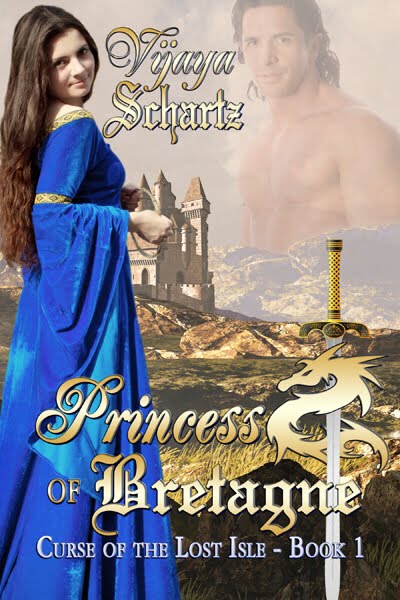
Book One - PRINCESS OF BRETAGNE: http://amzn.com/B007K1EGAM
Book Two - PAGAN QUEEN: http://amzn.com/B007Z8F7IA
Book Three - SEDUCING SIGEFROI: http://amzn.com/B008LW18EG
LADY OF LUXEMBOURG (Book 4): is scheduled for release later this year.
Grab it, like it, give it some love with "likes" and tags.
Hope you enjoy the read.
Vijaya Schartz
Tuesday, July 17, 2012
The Fun Part of Writing - Putting "Pencil to Paper"
I am so happy to be concentrating in earnest on writing book three of the Evolution Series, called Vain. After spending most of May finalizing a completely unrelated historical romance, Sass Meets Class, and most of June working on promotion for it, getting back to the craft of stringing words together is a welcome thrill. Every time I get to this point in in the writing process I literally feel a "Whee!!!" kind of excitement because the hours spent putting words in the document (I don't really write with a pencil and paper) are what I love about being an author and what compels me to continue.
I am trying a new, more disciplined approach: writing the story in chronological order (for the most part). I did cheat ahead twice but am now committed to taking it from beginning to end because some great threads are starting to sneak out of my brain, and I mean that almost literally since the heroine works with fabric.
So, who is Vain about? The hero is Theophilus (Theo), who was introduced in book one as David's best friend. Theo is dedicated to his responsibilities as a nobleman in the Carolingian Empire . His heroine is Lily, the daughter of the town's weaver and tailor. The class difference between nobility and artisan/merchant will be one of the conflicts between hero and heroine. Lily thinks she knows how her life will spin out, but starting from the first scene, her plan begins to unravel.
If you read book one, Unbidden, you might remember that Theo once stated he needs a wife who can sew because she will save him a fortune on his clothing. (Theo is a bit of a clothes-horse.) I am giving him his seamstress, and using themes of fabrics and their colors and textures in the building romance.
The writing also flows little more easily since this is the third installment in the same series, so I am comfortable with the time period, terminology, and the way I want to manage dialogue. Now that the plotting and timelines and character names for Vain are all planned, I can let the story flow and for me, that is the really fun, really inspiring part of authorship. Whee!!
What is your favorite part of writing, or if you are a reader, what touches can an author add to a book that really makes you appreciate their craft?
Thursday, July 12, 2012
SEDUCING SIGEFROI - the cover process - by Vijaya Schartz
After PRINCESS OF BRETAGNE and PAGAN QUEEN, comes the third book in the Curse of the Lost Isle series, SEDUCING SIGEFROI.
You wouldn't believe all the work Michelle and Judith went through, researching the perfect characters for the cover. In this case, Sigefroi of Luxembourg, the hero, is a real character, the founder of a dynasty that became very influential later in history. As such, there are representations of Sigefroi on stained glass windows, and written descriptions of him in history books.
Sigefroi had red hair and light hazel eyes, which was a common thing for a germanic knight of the period. Finding a red-haired cover model to fit the bill, however is an impossible task.
I've given my opinion on several pictures and sent pictures I found that might work, in order to help, but I realize how difficult it is.
As for the heroine, Melusine the Fae, she is even more difficult to pinpoint. She is an ondine. She is a woman most of the time, but one day each month she becomes a mermaid, a serpent from the waist down. She sometimes dresses in chainmail, rides a white horse, and wields a magic sword. Here is the best representation I could find of her transformation at sunset.
Oh, and here is a picture of the Bock of Luxembourg, a castle (now in ruins) at the top of a cliff. Can you see the Roman bridge at the very bottom? That's where Sigefroi and Melusine meet for the first time.
I can't wait to see what the very talented Michelle Lee who designs the book covers for Books We Love will come up with. But judging by what she did with the previous covers, I know it will be great.
Vijaya Schartz
Swords, Blasters, Romance with a Kick
Find her books on Amazon HERE
Friday, May 25, 2012
Meet Medieval author Laurel O'Donnell
Laurel O’Donnell has won numerous awards for her works, including the Holt Medallion for A Knight of Honor, the Happily Ever After contest for Angel’s Assassin, and the Indiana’s Golden Opportunity contest for Immortal Death. The Angel and The Prince was nominated by the Romance Writers of America for their prestigious Golden Heart award. O’Donnell lives in Illinois with her four cherished children, her beloved husband and her five cats. She finds precious time every day to escape into the medieval world and bring her characters to life in her writing.
The Angel and the Prince
In this exciting medieval romance, the French lady knight known as the Angel of Death wages a battle of wills and desires against her dreaded enemy — the English warrior known as the Prince of Darkness.
Ryen De Bouriez is a French warrior, dedicated to protecting her country against the hated English. In place of glittering ball gowns, she wears shining armor. Instead of practicing the gentler arts, she wields a sword. Those who whisper her name in fear and awe call her the Angel of Death.
Bryce Princeton is the Prince of Darkness, an English knight sent by his king to find and destroy their most hated adversary — the Angel of Death. Little does he know that his enemy is no man at all, but a beautiful woman who will challenge his heart and honor at every turn.
Forced to choose between love and honor, the Angel and the Prince wage a battle of wills that challenges everything they have ever believed in.
Buy Link
http://www.amazon.com/The-Angel-Prince-ebook/dp/B004LGTR1M/ref=sr_1_1?ie=UTF8&qid=1337564150&sr=8-1
A Knight of Honor
Taylor Sullivan is a raven-haired hellion fleeing the tragic flames that destroyed her family. She arms herself with a quick sword and a sharp tongue, hiring herself out as a mercenary, willing to do whatever it takes to survive.
Slane Donovan is a knight of honor, sworn to uphold his oath and his word. He seeks the woman who wears the Sullivan ring, determined to bring her back to Castle Donovan to fulfill a promise made to his brother.
When he finds the fierce young beauty, her sensual innocence inflames his heart, threatening to destroy the very essence of who he is and the vows he has sworn to uphold.
But there are others who seek the Sullivan woman as well, men who pose a far greater threat. Slane must protect his fiery mercenary companion from attacks, but can he protect himself from her undeniable charms?
More books from Laurel to come in a few days. Stay tuned. In the meantime, find out more about her and her books on her website at:
Sunday, April 29, 2012
Book 2 of the Curse of the Lost Isle is out! by Vijaya Schartz
CURSE OF THE LOST ISLE SERIES:
From history shrouded in myths, emerges a family of immortal Celtic Ladies, who roam the medieval world in search of salvation from a curse. For centuries, imbued with hereditary gifts, they hide their deadly secret... but if the Church ever suspects what they really are, they will be hunted, tortured, and burned at the stake.
Find the two books in kindle HERE
PRINCESS OF BRETAGNE:806 AD - Alba (Ancient Scotland) - As the Vikings raid the coast of Alba, Pressine of Bretagne sets out to seduce King Elinas of Dumfries, chosen by the Goddess to unite the tribes against the foreign invader. Elinas, still mourning his departed queen, has no intention to remarry. Head-strong and independent, Pressine does not expect to fall for the very attractive, wise and noble ruler... Furthermore, her Pagan nature clashes with the religious fanaticism of the king’s Christian heir, who suspects her unholy ancestry and will stop at nothing to get rid of her.
Many other books will follow, but these two books are companions and feature the same main characters.
Hope you are enjoying this series.
Vijaya Schartz
Swords, Romance with a Kick
http://www.vijayaschartz.com/
Monday, April 16, 2012
Invasion and Conquest invaluable gifts for the writer

My books, The Viking's Defiant Bride and its sequel, The Viking's Touch, cover a 25 year period involving massive social upheaval. This began with the Great Viking Invasion of 865AD when the sons of Ragnar Lodbrok, incensed by the news of their father's death at the hands of King Aella of Northumbria, sought vengeance. Thus they gathered a huge army and took ship for England. Aella's death was equally gruesome when the Vikings caught up with him: the ritual blood eagle sacrifice, with salt thrown into the wounds for good measure. Unlike previous incursions though, this time the invaders had come to stay. The transition period, before the conquerors became established settlers, seemed to offer numerous possibilities for the writer and it was something I was keen to explore. My hero, Wulfrum Ragnarsson, is a warlord with the Great Army. Loyal service wins him an estate and with it a beautiful and fiery Saxon bride, Elgiva. Marriage to the Viking means that she is forced to live between two worlds, tested by both and torn by divided loyalties. Complicating matters further is the increasing attraction she feels for Wulfrum whose heart seems an impenetrable as his mail shirt.
The Laird's Captive Wife is also concerned with a time of political and social turmoil: The Harrying of the North in the winter of 1069-70. Harrying is something of a euphemism. These days we call it genocide, and the episode ranks as the most infamous of all King William's deeds. William the Bastard seems to have lived up to his name in every way. On his deathbed he may have caught a whiff of sulphur because, allegedly, he confessed that the harrying troubled his conscience. My heroine, Ashlynn, and her family are caught up in these events. When her home is destroyed and her relatives slain, she becomes a penniless fugitive. Nevertheless, nothing is so bad it can't get worse, as she discovers when she falls into the clutches of the notorious warlord, Black Iain McAlpin. He has an agenda of his own and Ashlynn isn't part of it, until King Malcolm takes a hand and commands him to marry her. Alone and powerless, Ashlynn is forced to comply. She is taken thence to Dark Mount, an impregnable fortress in remote Glengarron. There she must come to terms with life in the wild and lawless Scottish borderlands, and with the dangerously charismatic man who is now her husband and who means to claim her for his own.
Thursday, April 5, 2012
ENTER MY CONTEST TO WIN PAGAN QUEEN - by Vijaya Schartz
PAGAN QUEEN is the continuation of PRINCESS OF BRETAGNE, starting a few years later, in 810. Although each novel is a complete story, the second book involves the same main characters in an intense plot, with lots of action, where Pressine, the heroine, has to face ruthless enemies and incredible obstacles. But do not fear, this is still a romantic novel, and she and her king will find their happiness in the end.... but I can guarantee you'll doubt it many times before it's all over.
PAGAN QUEEN is scheduled for release from Books We Love sometime this month, I don't know exactly when yet, but that release date will mark the end of the contest without warning, so do not wait.
In the meantime, you can find PRINCESS OF BRETAGNE, the book where this story started, in kindle for $2.99 HERE
This is what PAGAN QUEEN is about:
810 AD - Alba (Ancient Scotland)
Queen at last, Pressine brings victory to her beloved Elinas and prosperity to their growing kingdom. Still, she has to contend with the intrigues of Charlemagne's bishops, spurred by her Christian stepson. While Elinas, on the battlefield, remains unaware of his son’s machinations, Pressine fends off repeated assaults against her life. She also fears the curse that could bring her downfall. For the love of Elinas, she will tempt fate and become with child. But when her indomitable passion challenges the wrath of the Goddess Herself... can she win that battle?
Did I mention that Jimmy Thomas is on the cover of the first book, and I hope he is again on the cover of Pagan Queen, since that novel features the same hero.
Good luck in the contest.
Vijaya Schartz
check out the entire CURSE OF THE LOST ISLE series HERE
Saturday, March 31, 2012
HAVE YOU HUGGED A MEDIEVALIST TODAY? IT'S HUG A MEDIEVALIST DAY!
I swear I didn't make it up. I just found out on the internet a few days ago that March 31st is "HUG A MEDIEVALIST DAY." There had to be one of those. After all, nowadays, there is a day for almost everything.
Although I don't consider myself a medievalist (maybe I should), I'll take a cyberhug, or congrats, or kudos from anyone anytime. So March 31st is just as good as any a day to get it. Cyberhugs, I mean. You are welcome to comment and hug the contributors to this blog. They are all experts in the medieval period, so that must make them medievalists. After all, they researched the medieval period and became experts, enough to write believable romantic fiction in the genre.
So here is my cyberhug to all medievalists out there today. May your knowlege enlighten those avid for medieval things, may your stories find a loyal audience, may you all prosper and collect the rewards of all your shared knowledge.
Now, your turn. Tell us why you like medievalists.
Visit our favorite medievalists' websites at:
Denise Domning
Vijaya Schartz
Kris Tualla
Saturday, March 24, 2012
Why Medieval? by Author Deborah Kinnard
So you say you want to write a story set in the middle ages. Good for you! In our market, medieval fiction is somewhat under-represented. Of course, where a vacuum exists of any sort, nature (or writers) tend to want to fill it...
Many reasons can be found for setting a story in this fascinating time period. For one thing, the question of faith—how many of us can imagine living in a land where everyone is (at least nominally) a believer? Medieval Europeans took for granted that Jesus is Lord, to the glory of God the Father. These weren’t matters for discussion or question—they simply were. Faith informed people’s lives, and if they questioned, they did so privately.
This pervasive mindset makes for interesting fiction. Medieval people, and your characters as well, will live and walk and work with their faith an ever-present part of their lives. The church was all-embracing and all-pervasive. No matter how deeply a modern character feels and lives his faith, there is a difference—for the medievals, it existed everywhere.
Now that you’ve decided this is for you, the first question is: which middle ages do you want as your setting? If it’s fantasy-medieval, where lovely maiden Rapunzel waits in her high tower for her stalwart knight to come rescue her—this is for discussion elsewhere.
Instead let’s say your project will be set in the ACTUAL middle ages. What must you do so it reads real? Understand first that the best we modern-era writers can do is to approximate how people lived, spoke, and thought. This doesn’t, however, give license to get the period-based facts wrong.
Let’s assume you “know” your story. Some months before you start to write, you must decide on your setting. Let’s say it’s England. What do you know about England in your era of choice?
If, like many of us, you decide “not enough”, you begin to research. Very soon you find that the breadth of data on your chosen time-period varies greatly according to that time period. There is, however, a wealth of information about the British Isles in the middle ages. More accumulates in the body of knowledge all the time. This is because, alone of all the European nations in their birth-years, England has a rich trove of documents and artifacts which have survived the centuries.
How will you pick what information to include in your story, and what to leave aside? After all, you’re writing a novel, a work of fiction, not a scholarly tome for academics to dissect and argue over. One idea is to keep a separate document, either in Word or Notepad or even the handy MS One Note, for the research items that seem pertinent to your story.
You may end up using all of them. You may use none. Possibly you decide some are fascinating, but do not move your story forward and therefore must be left out. Whether you’re a dedicated plotter or a free-wheeling seat-of-the-pants writer, you’ll need to make a research treasure trove of your very own.
Your characters as they gestate in your mind will dictate some of what you are researching, and how deeply you dig. It’s possible also to mark a spot as you write, where more digging is needed, and return to it at a later time. I change the font color to red so that I can more clearly see the “more research” note on the screen. Some authors bookmark the spot in Word, others highlight.
Questions that might arise may include such things as how did your knight cushion his armor to prevent its chafing his skin? What did your serving maid wear? In what year did English people first use table forks?
You’ll need to research these things, rather than making them up as you go. Yes, you’re writing fiction, but depend on this: if you fudge an item, some more knowledgeable zealot-reader WILL catch it and call you out on it.
Granted, in places history shrouds her secrets and we won’t find out everything we need. Above all, whether you’re looking to market your story to a specific publisher or you’re writing with a distant dream of publishing the project, be aware of the need to make your characters true to their own era.
Creating a feisty, spunky heroine will work great for a contemporary, but would she really act this way in the thirteenth century? Or would she conform to that age’s attitudes about women? If at any moment she feels rebellious, will she voice her opinions or keep them to herself? Can she read? If so, you must explain why. Until the late fourteenth century, this skill was felt to be inappropriate outside the Church or the highest nobility.
Is he an atheist? If so, he can’t be vocal about it, unless it works better for your story that he be brought up on charges for heresy. Does he embrace tolerance of races and peoples outside his own? Then your character may ring untrue to some of the more racist views the medieval centuries held.
When you write in this era, you’re reaching for mindsets and attitudes many of which we no longer honor. Give the age its due by making your characters true to that age’s spirit, and not necessarily like ours. This can be a hard line to walk when writing, because of course our readers are our contemporaries and we’re reaching into their mindset, not those of our characters.
There is much to admire about the medievals, and much that resonates with our own experience. Love, grief, loyalty, friendship endure through the ages. Writing in this setting merely means you must call up different ways of expression to do them justice.
Now, on specific research, some suggestions for sites I’ve found profitable:
http://www.regia.org/ The Regia Anglorum site is full of period detail, provided by re-enactors who have done the jobs they describe.
http://www.sca.org/ The Society for Creative Anachronism is a group of dedicated re-enactors. They focus on the long stretch between the Roman twilight and the 16th century.
www.milieux.com/costume for details about dress and its creation.
http://www.behindthename.com/ – to research what names mean and whether they might’ve been used in your century. You really don’t want a medieval maiden named Tiffani.
http://www.etymonline.com/ – to look up a word. You may want to see whether your word of choice even existed in your chosen time.
http://www.plantagenetdynasty.blogspot.com/ – a blog about the royal family in the 13th and 14th centuries.
http://www.middle-ages.org.uk/ – to find out about life and customs of the English medieval period.
http://www.saints.sqpn.com/ – for information on saints and who is the patron of what area of life, the legends that grew up about them, and when their feasts are celebrated.
http://wychwood.wikidot.com/ – a re-enactors’ recreation of medieval life, complete with a town they are building, recipes for medieval food, etc.
http://www.saradouglass.com/relfest.html -- a site that will let you figure out whether Easter fell in March or April that year, and many other “movable feasts.”
http://www.medievalists.net/ – a potpourri site – a little of everything.
Seasons in the Mist
by Deborah Kinnard
Category: Fiction / Romance / Time Travel
Imprint: Sheaf House
Format: Trade Paperback / 5.5 x 8.5, 336 pages
ISBN: 978-0-9824832-1-3
Price: $13.99
Stranded in 1353 Cornwall, American graduate student Bethany Lindstrom knows she must find a way back to her own time or face a life of falsehoods and peril. But with the stern overlord Sir Michael Veryan, she is swept into the intrigues of King Edward’s court, which will test their mettle and their faith in God to the limits—and forever bind their lives together.
Purchase using the following links:
Amazon
Kindle
Barnes & Noble
Nook
Books-a-Million
Many reasons can be found for setting a story in this fascinating time period. For one thing, the question of faith—how many of us can imagine living in a land where everyone is (at least nominally) a believer? Medieval Europeans took for granted that Jesus is Lord, to the glory of God the Father. These weren’t matters for discussion or question—they simply were. Faith informed people’s lives, and if they questioned, they did so privately.
This pervasive mindset makes for interesting fiction. Medieval people, and your characters as well, will live and walk and work with their faith an ever-present part of their lives. The church was all-embracing and all-pervasive. No matter how deeply a modern character feels and lives his faith, there is a difference—for the medievals, it existed everywhere.
Now that you’ve decided this is for you, the first question is: which middle ages do you want as your setting? If it’s fantasy-medieval, where lovely maiden Rapunzel waits in her high tower for her stalwart knight to come rescue her—this is for discussion elsewhere.
Instead let’s say your project will be set in the ACTUAL middle ages. What must you do so it reads real? Understand first that the best we modern-era writers can do is to approximate how people lived, spoke, and thought. This doesn’t, however, give license to get the period-based facts wrong.
Let’s assume you “know” your story. Some months before you start to write, you must decide on your setting. Let’s say it’s England. What do you know about England in your era of choice?
If, like many of us, you decide “not enough”, you begin to research. Very soon you find that the breadth of data on your chosen time-period varies greatly according to that time period. There is, however, a wealth of information about the British Isles in the middle ages. More accumulates in the body of knowledge all the time. This is because, alone of all the European nations in their birth-years, England has a rich trove of documents and artifacts which have survived the centuries.
How will you pick what information to include in your story, and what to leave aside? After all, you’re writing a novel, a work of fiction, not a scholarly tome for academics to dissect and argue over. One idea is to keep a separate document, either in Word or Notepad or even the handy MS One Note, for the research items that seem pertinent to your story.
You may end up using all of them. You may use none. Possibly you decide some are fascinating, but do not move your story forward and therefore must be left out. Whether you’re a dedicated plotter or a free-wheeling seat-of-the-pants writer, you’ll need to make a research treasure trove of your very own.
Your characters as they gestate in your mind will dictate some of what you are researching, and how deeply you dig. It’s possible also to mark a spot as you write, where more digging is needed, and return to it at a later time. I change the font color to red so that I can more clearly see the “more research” note on the screen. Some authors bookmark the spot in Word, others highlight.
Questions that might arise may include such things as how did your knight cushion his armor to prevent its chafing his skin? What did your serving maid wear? In what year did English people first use table forks?
You’ll need to research these things, rather than making them up as you go. Yes, you’re writing fiction, but depend on this: if you fudge an item, some more knowledgeable zealot-reader WILL catch it and call you out on it.
Granted, in places history shrouds her secrets and we won’t find out everything we need. Above all, whether you’re looking to market your story to a specific publisher or you’re writing with a distant dream of publishing the project, be aware of the need to make your characters true to their own era.
Creating a feisty, spunky heroine will work great for a contemporary, but would she really act this way in the thirteenth century? Or would she conform to that age’s attitudes about women? If at any moment she feels rebellious, will she voice her opinions or keep them to herself? Can she read? If so, you must explain why. Until the late fourteenth century, this skill was felt to be inappropriate outside the Church or the highest nobility.
Is he an atheist? If so, he can’t be vocal about it, unless it works better for your story that he be brought up on charges for heresy. Does he embrace tolerance of races and peoples outside his own? Then your character may ring untrue to some of the more racist views the medieval centuries held.
When you write in this era, you’re reaching for mindsets and attitudes many of which we no longer honor. Give the age its due by making your characters true to that age’s spirit, and not necessarily like ours. This can be a hard line to walk when writing, because of course our readers are our contemporaries and we’re reaching into their mindset, not those of our characters.
There is much to admire about the medievals, and much that resonates with our own experience. Love, grief, loyalty, friendship endure through the ages. Writing in this setting merely means you must call up different ways of expression to do them justice.
Now, on specific research, some suggestions for sites I’ve found profitable:
http://www.regia.org/ The Regia Anglorum site is full of period detail, provided by re-enactors who have done the jobs they describe.
http://www.sca.org/ The Society for Creative Anachronism is a group of dedicated re-enactors. They focus on the long stretch between the Roman twilight and the 16th century.
www.milieux.com/costume for details about dress and its creation.
http://www.behindthename.com/ – to research what names mean and whether they might’ve been used in your century. You really don’t want a medieval maiden named Tiffani.
http://www.etymonline.com/ – to look up a word. You may want to see whether your word of choice even existed in your chosen time.
http://www.plantagenetdynasty.blogspot.com/ – a blog about the royal family in the 13th and 14th centuries.
http://www.middle-ages.org.uk/ – to find out about life and customs of the English medieval period.
http://www.saints.sqpn.com/ – for information on saints and who is the patron of what area of life, the legends that grew up about them, and when their feasts are celebrated.
http://wychwood.wikidot.com/ – a re-enactors’ recreation of medieval life, complete with a town they are building, recipes for medieval food, etc.
http://www.saradouglass.com/relfest.html -- a site that will let you figure out whether Easter fell in March or April that year, and many other “movable feasts.”
http://www.medievalists.net/ – a potpourri site – a little of everything.
Seasons in the Mist
by Deborah Kinnard
Category: Fiction / Romance / Time Travel
Imprint: Sheaf House
Format: Trade Paperback / 5.5 x 8.5, 336 pages
ISBN: 978-0-9824832-1-3
Price: $13.99
Stranded in 1353 Cornwall, American graduate student Bethany Lindstrom knows she must find a way back to her own time or face a life of falsehoods and peril. But with the stern overlord Sir Michael Veryan, she is swept into the intrigues of King Edward’s court, which will test their mettle and their faith in God to the limits—and forever bind their lives together.
Purchase using the following links:
Amazon
Kindle
Barnes & Noble
Nook
Books-a-Million
Friday, March 23, 2012
Meet medieval author Kris Tualla
Kris Tualla's motto is: "Norway is the new scotland." She has it on tee-shirts and mugs and her medieval novels feature Scotland and Norway.
She writes gritty historical novels, not all medieval, but all very well written and fascinating. Her writing style places you right in the middle of the action and you really feel for her characters.
She presently lives in Arizona. She will be attending the Romantic Times Conference in Chicago the first weekend of April, the Desert Dreams Writers Conference on April 27-29 in Scottsdale Arizona, and the AZDreamin' Readers Convention on June 2, 2012 in Chandler Arizona.
Here are what her two purely medieval romantic novels are about:
LOVING THE NORSEMAN - 1354
Grier MacInnes buried three fiancés in the Black Death; soon she'll be replaced by her cousin's teen bride as Lady of Durness Castle. After two decades in Greenland, Rydar Hansen is desperate to return to Norway and reclaim his inheritance ~ if he still has one. Thrown together by a North Sea storm, they don't speak the same language. But apart from each other, they have no future.
*****
"LOVING THE NORSEMAN has a lovely cast of characters, and a nice, cinematic quality to it. I also liked the balance Ms. Tualla creates in Ryder's character, allowing him to be vulnerable yet strong."
~ Grand Central Publishing
LOVING THE KNIGHT - 1355
Lady Eryndal Bell is a fraud. A bastard orphan, she has claimed the Bell estate in the aftermath of the Black Death. When Lord Andrew Drummond, courtier to King David II, arrives Eryn hides her treasonous deception from the knight, despite his passionate proposal. After Drew discovers her lies, will he convince the king to spare her life? And will either one move beyond their stubborn pride and painful pasts to salvage love ~ before it's too late?
Happy readings.
Subscribe to:
Posts (Atom)