Showing posts with label history. Show all posts

Sunday, June 21, 2015

A ROSE BY ANY OTHER NAME - by Vijaya Schartz

If you were born in June, your birth flower is the rose, and your birth stone the pearl. Another June flower is the honeysuckle, a symbol of everlasting love, often mentioned in medieval songs. But these gorgeous long stem roses we know today do not exist in nature. They are hybrids manipulated by man for millennia, to enhance their beauty or their fragrance.

Most species of roses came from Asia along the silk road and were cultivated in northeast Africa and the near east as far as five thousand years ago. Ancient Zoroastrian texts mention roses with hundreds of petals, and the legends say that originally the rose didn’t have thorns. The thorns only appeared when evil descended to earth.

Alexander the Great discovered the rose in Persia, and the Roman emperors soon followed in his steps and fell in love with it. The Romans brought the white rose with them all the way to England where it flourished. In Rome, they used it lavishly and even to excess. Nero was known to bury his banquet guests under mounds of rose petals, to the point of suffocation. After the fall of the Roman Empire, during the dark ages and the barbarian invasions, the rose that had symbolized the oppressor was shunned in most of Europe and mostly forgotten. The early middle ages only knew the primrose, the hawthorn, climbing rose vines, and other wild varieties of the rose family, native to Europe.


As Islam spread over the middle east, the oriental rose supplanted the lotus as the queen of all flowers. The Turks and the Persians of the time believed that roses were born from drops of sweat from their holy prophet. Soon, their passion for roses spread to Arabia. As early as the tenth century, the Arabs, who perfected the process of distilling perfumes, traded rose water and rose-perfumed oils as valuable commodities to their occupied territories in Spain, and even to China.

In the twelfth century, the Crusaders returning from Jerusalem and Constantinople brought the beautiful rose back to Europe, along with its legends, its fragrance, and its healing powers. Robert de Brie brought to France the Damask rose. With new influx from the middle east, rose water became the rich women’s favorite luxury. So much so that the most ascetic leaders of the Church felt the need to forbid such decadence, considering it sinful.

It didn’t prevent medieval women from growing their own rose gardens inside the walls of their fortresses, where they enjoyed spinning, sewing, and embroidering among the fragrant flowers. Soon they learned to distill their own rose water and later made their own perfumes, especially in Provence, where the climate allows the flowers to grow in abundance.

Queen Eleanor of Provence, who married Henry III of England, was the first to adopt a white rose as her family emblem. Her son Edward also chose a rose. The houses of York and Lancaster made their family symbols famous in the War of the Roses. Later, the Tudors combined the two roses into a double rose.

Rosa in Latin is the verb “to love,” and Rose in French is the color pink, the color of most wild roses. In late medieval times, the rose became a cherished symbol in many courtly love stories and legends. My Curse of the Lost Isle series is inspired by such authentic legends.
 

BELOVED CRUSADER
Curse of the Lost Isle Book Six (standalone)
 
1096 AD ‑ To redeem a Pagan curse, Palatina the Fae braves the Christian world to embark on an expedition to free the Holy Sepulcher in Jerusalem from the Turks. Pierre de Belfort, Christian Knight of Lorraine, swore never to let a woman rule his life, and doesn't believe in love. Thrown together into the turmoil of the First Crusade, on a sacred journey to a land of fables, they must learn to trust each other. For in this war, the true enemy is not human... and discovery could mean burning at the stake.

Find all my books on: AMAZON  -  B&N - ARE - SMASHWORDS  -  iBOOKS  etc. 

Monday, September 23, 2013

Researching Medieval Times in pictures - by Vijaya Schartz


Castle in Forez
The Curse of the Lost Isle is an ongoing series that will include many installments.

I am currently writing Book 5 - CHATELAINE OF FOREZ, to come out this winter, but as I research small details, I come across fodder for my future novels in the series. 

This book will again feature Melusine the Fae, a princess of Strathclyde, former lady of Luxembourg, but a few decades have passed.

The Curse of the Lost Isle series
4 books published so far - in kindle only
 

Arms of Forez
This is the banner of Forez, and the golden dolphin represents Melusine the Fae, a water creature. As many of you know, Melusine is immortal, but cursed to become a water serpent from the waist down one day each month. At the start of the 11th Century, she roams the swamps, lakes, springs, and rivers of Forez, where she meets Count Artaud, a Pagan knight, who might be the reincarnation of Melusine's very first love, Sigefroi of Luxembourg.

During research, I'm often distracted by facts and images that pop up in my searches. I'm very visual, so images bring up a slew of ideas.


Book 6 will cover the first Crusade, and it became difficult to remain focused on the book I'm presently writing, so I decided to stash away pictures and information for the future books in the series. Here are some of my precious finds I stashed on Pinterest for my next novel. 

Godfrey of Bouillon 1st Crusader
Godfrey of Bouillon (in Belgium) will be a character in Book 6. He initiated the first knights' Crusade, which will serve as the backdrop for that novel.

But right now, I have to get back to writing Book 5, CHATELAINE OF FOREZ, so you can enjoy it during the holidays.

Wishing you all HAPPY READING.

Vijaya Schartz
Swords, Romance with a Kick
http://www.vijayaschartz.com


B&N: http://www.barnesandnoble.com/c/vijaya-schartz
FB: https://www.facebook.com/vijaya.schartz
Twitter:
https://twitter.com/Vijayaschartz 


Saturday, January 19, 2013

Lady of Luxembourg has a kick-ass cover - by Vijaya Schartz


This is a first peek at the cover of LADY OF LUXEMBOURG, Book 4 in the Curse of the Lost Isle medieval series. The artist is Michelle Lee, and she designed it for Books We Love. I absolutely love it. My heroine is depicted as Fae, strong, and wielding magic. Also love the sword with the mermaid. The sword runs through all the covers in the series, but the first two books had a dragon, and since this heroine is an ondine (she transforms into a mermaid on specific days), it keeps the theme running.

Fire is also a strong element in this particular novel. The fires of hell, the threat of being burned at the stake, and the magic fire Melusine wields in the service of the Pagan Goddess she worships.

I hope you like the cover as much as I do. I did have some input in this cover and I am very grateful my publisher is allowing me to participate to this degree.

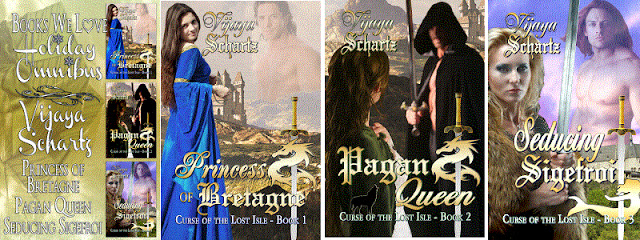
The book should be out in kindle in a few days. In the meantime, don't forget to re-read or read the first three books, PRINCESS OF BRETAGNE, PAGAN QUEEN, and SEDUCING SIGEFROI. You can find them all in kindle at AMAZON


Happy Reading!

Vijaya Schartz
Blasters, Swords, Romance with a Kick

Thursday, July 19, 2012

Seducing Sigefroi is out! - by Vijaya Schartz

Yes, this is the definite cover, and I'm very happy with it. The heroine looks like a dark water creature and wields a sword. He looks fierce, not as red-headed as the real Sigefroi, but so yummy, who cares?

SEDUCING SIGEFROI IS OUT IN KINDLE!

Luxembourg - 963 AD - To offset the curse that makes her a serpent from the waist down one day each month, Melusine, exiled Princess of Strathclyde, must seduce and wed a mortal knight, the shrewd and ambitious Sigefroi of Ardennes.

Sigefroi, son of the Duke of Lorraine, suspects Melusine is not what she appears, but her beauty, her rich dowry, and her sharp political skills serve his ambitions. He never expected her to soften his stone-cold warrior heart.

So close to the Imperial court, dangers and intrigue threaten Melusine. War looms on the horizon, a Mermaid was sighted around Luxembourg, and Sigefroi’s bishop brother questions her ancestry. If anyone ever suspects Melusine’s true nature, she will burn at the stake...

FIND ALL THE BOOKS IN THE SERIES SO FAR:

Book One - PRINCESS OF BRETAGNE: http://amzn.com/B007K1EGAM
Book Two - PAGAN QUEEN: http://amzn.com/B007Z8F7IA
Book Three - SEDUCING SIGEFROI: http://amzn.com/B008LW18EG

LADY OF LUXEMBOURG (Book 4): is scheduled for release later this year.

Grab it, like it, give it some love with "likes" and tags.
Hope you enjoy the read.

Vijaya Schartz

Tuesday, April 3, 2012

Travel Through Time, by Jill Hughey


Travel Through Time:  In my last few blog entries I have been discussing the kinds of research needed to make historical fiction accurate, or at least not ridiculously inaccurate.  For most historical novels, the author has to become familiar with the modes of travel.  Even the most protected or ignored romantic characters get at least one or two journeys in their story (think of Jane Austen's Emma or Anne Elliott). How did people get around in the world?  How long did it take to go from point A to point B?  Would they enjoy the trip or would it be an arduous or dangerous undertaking?

Even if our main characters never leave their homes, other players probably have to come and go from our setting in order to keep the story interesting.  Understanding the ways people travelled during a time period can be a challenge but can also add a wonderful element of human progress.  I wrote a short romance call Sass Meets Class- soon to be released - set in Arizona in the 1880s.  I had a very specific time span in mind due to some other actual events that happened around my location.  This was also when railroads were just being built in the region so I had to determine exactly when each line was completed and how that might affect the hero and heroine's movements.  It actually worked out quite well because I was able to bring my hero back to the love of his life much more quickly by train than when he left her behind on horseback.

This leads into how the time required to make a journey can be important to the story.  Figuring out the timeline of a story is one of the biggest challenges for me as a writer because I am always so impatient to start writing!  Once I have the timeline though, a journey has to be accounted for somehow, even if mentioned in one sentence.  For Redeemed, the second story in my Evolution Series, I had to figure out how long it would take my hero Doeg to return home from the Carolingian Army's summer camp in the year 834.  (Determining where the army camped that year was a whole different research topic.)  I knew he would be on a horse.  I had to decide what route he might take, how many miles or leagues that route would add up to, and how many miles or leagues a fully-loaded horse can travel day-after-day-after-day.  A good reference book for the correct time period is invaluable for this kind of information (I use Daily Life in the World of Charlemagne), especially the routes and speed of travel.  Obviously Doeg's horse would not compare to the modern horse so there is some value in finding as much information as you can from the right time in history.  It is doubtful that any book or internet search could tell me exactly how long it would have taken him to ride from Langres to Regensburg but I owe my readers at least a credible estimate.

The rigors of travel were very different depending on the time period, wealth of the traveler, mode of travel, and location.  Many of us are familiar with first kisses stolen in the confines of a luxurious carriage or the forbidden assignation in the deep of night at an inn.  Most of my characters live a slightly more rustic life.  In Unbidden my hero and heroine, David and Rochelle, travel for four days with a small group of travelers.  Unlike Doeg's eleven-day solo journey that I covered in one paragraph, I wrote something about every day of David and Rochelle's trip so David would have time to woo Rochelle as she tried to resist her developing affection for him.   Obviously they could not just float along talking to each other.  The logistics of the trip had to be at least mentioned or more preferably used to establish a strong sense of what traveling would be like in 831 Francia.  Where would they sleep?  Answer:  one night in the open, one night in a monastery, one night outside the walls of a monastery.  During one day they are in a huge thunderstorm with no shelter.  On another day Rochelle is set upon by two petty thieves.  Obviously these occurrences set up opportunities for David and Rochelle to interact but they were also very real dangers of travel in the Middle Ages.  Could one of them, on the other hand, get a bad case of poison ivy?  Preferably not, because poison ivy is indigenous to North America, not Europe.

Research, research, research.  Soon I will blog a little more about sources.

Some of my favorite "classic" romances are set on sailing ships.  What is your favorite or the most unique travel scenario you have encountered in books set on the planet Earth?

Friday, March 30, 2012

Historic Accuracy? Part Two: Modern Conveniences

Historic Accuracy?  Part Two: Modern Conveniences  

One of my major challenges in writing in 830s  Europe is making clear to the reader what is NOT there.  As an example, stirrups had not been added to saddles yet.  For modern readers, the stirrup is an integral part of every saddle they have ever seen or sat on but as an author I cannot just come out and tell them the saddle had no stirrups because the concept of a stirrup -- much less the term for it -- did not exist.  There is a scene in Unbidden, 
where my heroine has a difficult time mounting her horse under duress because she has become accustomed to the hero helping her.  The reason she struggles is because she has no stirrups and did not look around for a stump or log when she dismounted.  In my historical notes I mention the stirrup-less saddle but I am still not entirely satisfied with the actual scene because I did not find a way to tell the reader there are no stirrups.

Household fixtures that were not as hard to deal with but did require some thought.  Chimneys were not yet in use so I had to describe the hearth in the middle of the floor and the hole in the roof nor could I have those wonderful love scenes in front of the bedroom fireplace because there were no fireplaces.  Toilets were generally housed in outhouses though I chose to use the term "latrine".  Even something as universal as money requires research.  What denominations of currency were in use?  What did the coins looks like and what were they made of?

As a reader,  how much detail regarding everyday items do you like to have in historical romances you read?