Showing posts with label myths. Show all posts

Tuesday, May 10, 2022

Finding inspiration in history and myths - by Vijaya Schartz


amazon B&N - Smashwords - Kobo


“Any sufficiently advanced technology is indistinguishable from magic.” Arthur C. Clarke

amazon B&N - Smashwords - Kobo


All science fiction authors struggle to make their stories believable, because most of us only believe what we can explain and understand. Anything else is considered fantasy. And while we witness unexplained feats of magic and fantasy each day, like UAP (Unexplained Aerial Phenomena), ghosts, premonitory dreams, out of body or transcendental experiences, fiction writers are held to more stringent rules. Unlike reality, our stories have to make sense in the physical world.

Readers often tell me I have a fertile imagination, but to imagine the future, you only have to study the so-called mythology of many Earth cultures.

Lord Shiva claimed to be from another planet
and traveled through the air on a vessel surrounded by flames


Ancient civilizations worshipped gods who came come from the sky (heavens) in chariots of fire that rumbled like thunder. They were said to possess magical powers, like the power of flight, infinite knowledge, and incredible powers of destruction… powers we now understand as advanced technology.

They lived in magical cities in the sky, cities we would now call motherships, and they flew down in smaller crafts they called Vimanas. They also waged violent wars in the sky, with terrible repercussions for our planet.


Shiva (the destroyer of worlds) wielded weapons that could destroy entire planets and fiery arrows that never missed the target. 


The Shiva Lingam found in a multitude of temples, and long discarded as a fertility symbol, was recently recognized as an accurate representation of a nuclear cooling tower. Lingering radioactivity in ancient ruins and bones, along with vitrification of the stone (that only happens with the kind of heat produced by a nuclear explosion), and ancient manuscripts describing epic battles of the gods with such weapons in the same area, support the fact that a nuclear event must have happened around that time… several millennia ago.


In the subcontinent of India, these powerful beings, who visited Earth and lived among men in the faraway past, were not human. They had blue skin, several pairs of arms, sometimes a third eye, monkey heads, elephant head, or snake bodies, and claimed to have come from other planets. To the people of India, they were not mythical or gods, but flesh and blood beings from another place. The epic adventures depicted in the Vedas, the Bhagavad Gita, and the Mahabharata are not considered mythology but true ancient history and taught in schools as such.


But this phenomenon of alien visitors perceived as gods is not particular to India.

In the Buddhist world, the stone stupa inside which the statue of buddha resides represents some kind of transport craft to take him to the “cities in the sky.” Spaceships?


In China, the first emperor descended from the sky on a flaming dragon and claimed to come from space. To this day, the dragon is the symbol of China.


In Japan, Amaterasu, the goddess of light, came down to Earth to start the ruling dynasty to this day.


In my science fiction stories, my characters travel the galaxy, discovering new planets and cultures, or they are planet bound, visited by more advanced aliens. 

amazon B&N - Smashwords - Kobo


Vijaya Schartz, author

Strong Heroines, Brave Heroes, cats

Wednesday, June 28, 2017

Magical Ladies of the Lost Isle still inspire today's women

Available online in all ebook formats and paperback.

Myths and legends are often cautionary tales, but each of them relates to specific events and periods of the faraway past, and contains a kernel of truth. Even these immortal ladies were modeled on existing heroines of old, who influenced society in times of turmoil.
Beside the persecution of Pagans during the dark ages, many important historical events punctuate the lives of these immortal ladies. The Viking invasions in Scotland are front and center in books one and two. Then the foundation of Luxembourg in books three and four. Feudal life and religious struggles in France come to life in book five. The greatest adventure of all times, the Crusades with their different facets are depicted in books six and seven, and the best known legend of Melusine the Fae in Aquitaine, the cradle of many royal lines, comes to light in book eight.

But who were these strong women who fought to survive against all odds, in a world ruled by men, in a violent society where life had little value?

They were Celtic and Pagan. They did not abide by the rules of the new religion Charlemagne had imposed by the sword. They believed in equality and refused to bow to the will of the men who would tame and control them. They practiced kindness toward all and worked for the common good. Early on, they symbolized hope and freedom for many, especially the oppressed.
The ruins of the castles they built still stand. Here, Melusine's tower in Vouvant, Aquitaine.
These ladies were smart and astute politicians and influenced the rulers and the historical events of their day. They had the welfare of their community at heart. They fought for what was right in a world where the powerful held sway with ruthless violence, and often with impunity.

These ladies were not perfect. Far from it. Each of them made grave mistakes in their youth, using their powers for purposes other than the common good. For these mistakes, they were cursed, and spent their entire lives dealing with horrible woes... all the time struggling to hide their Pagan origins and avoid discovery by the Church... which would lead to burning at the stake. They also sought redemption in the eyes of their Pagan Goddess.
Melusine in her cursed shape still graces the walls of the castle of Lusignan
 Even in today's society, these ladies of old stand as a shining example. I loved writing about them. Their names are rarely mentioned in the history books, although they appear in many legends. But their famous and infamous descendants blazed new trails throughout history.

I hope when you learn more about them, you will like them as much as I do.

Vijaya Schartz
Action, Romance and Mayhem
http://www.vijayaschartz.com
Find my page and all my books on:

Saturday, April 8, 2017

Free and 99cts, Curse of the Lost Isle medieval series by Vijaya Schartz

https://www.amazon.com/dp/B008LW18EG/
Free in kindle until April 12, 2017
SEDUCING SIGEFROI
Book 3 in the Curse of the Lost Isle series
Medieval fantasy romance 
First book of Melusine (complete story)

Luxembourg - 963 AD - To offset the curse that makes her a serpent from the waist down one day each month, Melusine, exiled Princess of Strathclyde, must seduce and wed a mortal knight, the shrewd and ambitious Sigefroi of Ardennes. Sigefroi, son of the Duke of Lorraine, suspects Melusine is not what she appears, but her beauty, her rich dowry, and her sharp political skills serve his ambitions. He never expected her to soften his stone-cold warrior heart. So close to the Imperial court, dangers and intrigue threaten Melusine. War looms on the horizon, a Mermaid was sighted around Luxembourg, and Sigefroi’s bishop brother questions her ancestry. If anyone ever suspects Melusine’s true nature, she will burn at the stake... 
 
"As always, Schartz spins a great story. It’s a bit bloody and bloodthirsty in places... But that's part of the drama, and Schartz certainly knows drama." Manic Readers 4.5 stars

"Ms. Schartz did a fine job with this offering, and brought elements to the myth that fleshed Melusine out and made her a sympathetic character. I think fans of Fantasy romance will enjoy this steamy version of the myth and fans of the myth might find it interesting as well." - Julianne Draper - The Examiner

99cts in kindle until April 14, 2017
DAMSEL OF THE HAWK
Curse of the Lost Isle Book 7 (standalone)
medieval fantasy series

1204 AD - Meliora, immortal Fae and legendary damsel of Hawk Castle, grants gold and wishes on Mount Ararat, but must forever remain chaste. When Spartak, a Kipchak warrior gravely wounded in Constantinople, requests sanctuary, she breaks the rule to save his life. The fierce, warrior prince stirs in her forbidden passions. Captivated, Spartak will not bow to superstition. Despite tribal opposition, he wants her as his queen. Should Meliora renounce true love, or  embrace it and trigger the sinister curse... and the wrath of the Goddess? Meanwhile, a thwarted knight and his greedy band of Crusaders have vowed to steal her Pagan gold and burn her at the stake...

"It was easy to get lost in the latest Lost Isle book. I didn't want to put it down until I was finished. Each character added their own magic to the whole of the story. Authentic detail pulled me in as well. But the dog glued me to the tale as did the lovers in their struggles to HEA." Hope Chase 5-stars on Amazon

"...so vivid I could picture myself right there... tough, honorable alpha hero... fiercely protective and loyal mountain dog, Kopec... Meliora... hints of the strong, rebellious woman she actually is... not a simple HEA for them... but once they finally get it, it's wonderful!" Lisa on Amazon

"Historical romance with a different twist... a new spin on a classic tale... standalone... Ms. Schartz has a gift that will have readers asking for more and will have them intrigued by the idea of the other books in the series." Ind'Tale Magazine

Find the entire series in kindle HERE


Vijaya Schartz, author
Romance with a Kick
http://www.vijayaschartz.com

Monday, June 6, 2016

The story behind the CURSE OF THE LOST ISLE series

Vouvant walls - Postern gate
As I start writing the last book (#8) in the Curse of the Lost Isle series, I realize this project has been twenty years in the making. Twenty years? Where did the time go?

That summer of 1996, I was vacationing in my mother's village, in western France, a tiny place named Vouvant, voted one of the most beautiful villages in France. As I walked through the local museum, a silver and blue tapestry in a special exhibit piqued my curiosity. The scene of a noble wedding between Melusine the Fae and Sigefroi of Ardennes, first Count of Luxembourg. I did a double take. The date on the label: 963 AD.

You see, in Vouvant, Melusine the Fae is the local celebrity. Cursed since childhood to become a mermaid on certain days, she nevertheless married knight Raymond of Forez, with whom she started the famous and infamous family of Lusignan. Among her descendants are Eleanor of Aquitaine, Guy de Lusignan, Robert of Lusignan (Kings of Jerusalem and Cyprus) even King Richard the Lionheart. She built fortresses to protect the entire region and is said to have built the castle of Vouvant with the tower that bears her name in one night... to protect the village against invaders... but that was in the late eleventh or early twelfth century. So how could she be in Luxembourg in 963, even less marrying its founder, Count Sigefroi?

I could never resist a mystery, so I started digging. I went from local castles to museums, asking questions, visiting libraries, finding old accounts of ancient legends, translations and studies of medieval myths, gathering historical details. To my great surprise, Melusine the Fae appeared at different times in history in different places in Europe, with a similar curse and a different story. First in Luxembourg, then in Forez, and later in Lusignan near Vouvant.


I learned that her mother was Pressine the Fae, who married King Elinas of Alba (ancient Scotland) during the Viking invasions in the early 800s. Melusine also had two sisters, Palatina and Meliora. All of them cursed for abusing their powers in childhood. The only problem was, their story spanned too many centuries. From their birth in the 800s in Scotland during the first Viking invasions, all the way to the Crusades in the 1200s.


Melusine, Castle of Lusignan
The early accounts of the legends, written in the 1300s and the 1400s varied greatly. I found genealogies, scholarly studies of the myths, and a host of historical facts. The writer in me saw an opportunity. A series... a family of Fae... persecuted for their powers, roaming the medieval world in search of redemption from a curse... and they had to be immortal!

I wasn't published yet, but I had three manuscripts with an agent. When I returned home to Arizona, I told my agent about my idea and she gave me her blessing with great enthusiasm. So I started writing.

My agent shopped the idea for the series. No one wanted to hear about it. It was a mix of several genres, historical, fantasy, and romance. I didn't have a following to guarantee booming sales. No one wanted to take a chance on such a series... especially from an unknown author.


Melusine's tower in vouvant still stands today
In 2000, my first contemporary novel came out, then two science fiction novels. Many other sci-fi and romance novels followed with various publishers, but still no interest in my immortal ladies. My agent retired. I kept pitching the series to other agents and publishers. No dice. I put them on the back burner but kept writing and researching in my spare time. Over the next ten years, each trip back to Europe became an opportunity to research a different location where the legends occurred.

In 2010, I signed up with Books We Love Ltd, a Canadian publisher who was reissuing my back list of out of print books. They liked my writing and asked me if I had any original works for them to publish. I sent them the first book of my immortal ladies and they loved it. The rest is history. Seven books are now published in the Curse of the Lost Isle series. The latest, DAMSEL OF THE HAWK (the story of Meliora) came out last month, and I'm just starting the very last novel in the series, ANGEL OF LUSIGNAN, which should come out in December or January.

It boggles the mind that this series has been my obsession for the past twenty years. I hope the readers enjoy the experience I created for them. I'm going to miss these wonderful characters when I write "the end" on this last novel.


DAMSEL OF THE HAWK
Curse of the Lost Isle Book 7
in kindle and paperback: https://amzn.com/B01CH93SNM

1204 AD - Meliora, the legendary damsel of Hawk Castle, grants gold and wishes on Mount Ararat, but must forever remain chaste. When Spartak, a Kipchak warrior gravely wounded in Constantinople, requests sanctuary, she breaks the rule to save his life. The fierce, warrior prince stirs in her forbidden passions. Captivated, Spartak will not bow to superstition. Despite tribal opposition, he wants her as his queen. Should Meliora renounce true love, or  embrace it and trigger the sinister curse... and the wrath of the Goddess? Meanwhile, a thwarted knight and his greedy band of Crusaders have vowed to steal her Pagan gold and burn her at the stake...


The complete Curse of the Lost Isle series includes:
Book 1 - PRINCESS OF BRETAGNE (early story of Pressine)
Book 2 - PAGAN QUEEN (later story of Pressine) still 99cts?
Book 3 - SEDUCING SIGEGROI (early story of Melusine in Luxembourg) still 99cts?
Book 4 - LADY OF LUXEMBOURG (later story of Melusine in Luxembourg)
Book 5 - CHATELAINE OF FOREZ (story of Melusine in Forez)
Book 6 - BELOVED CRUSADER (story of Palatina First Crusade)
Book 7 - DAMSEL OF THE HAWK (story of Meliora exiled in Turkey)
Book 8 - ANGEL OF LUSIGNAN (last story of Melusine late 2016 or early 2017)

There is also a boxed set of the first 4 novels in kindle for a friendly price. CURSE OF THE LOST ISLE boxed set

HAPPY READING!

Vijaya Schartz
http://www.vijayaschartz.com

Sunday, June 21, 2015

A ROSE BY ANY OTHER NAME - by Vijaya Schartz

If you were born in June, your birth flower is the rose, and your birth stone the pearl. Another June flower is the honeysuckle, a symbol of everlasting love, often mentioned in medieval songs. But these gorgeous long stem roses we know today do not exist in nature. They are hybrids manipulated by man for millennia, to enhance their beauty or their fragrance.

Most species of roses came from Asia along the silk road and were cultivated in northeast Africa and the near east as far as five thousand years ago. Ancient Zoroastrian texts mention roses with hundreds of petals, and the legends say that originally the rose didn’t have thorns. The thorns only appeared when evil descended to earth.

Alexander the Great discovered the rose in Persia, and the Roman emperors soon followed in his steps and fell in love with it. The Romans brought the white rose with them all the way to England where it flourished. In Rome, they used it lavishly and even to excess. Nero was known to bury his banquet guests under mounds of rose petals, to the point of suffocation. After the fall of the Roman Empire, during the dark ages and the barbarian invasions, the rose that had symbolized the oppressor was shunned in most of Europe and mostly forgotten. The early middle ages only knew the primrose, the hawthorn, climbing rose vines, and other wild varieties of the rose family, native to Europe.


As Islam spread over the middle east, the oriental rose supplanted the lotus as the queen of all flowers. The Turks and the Persians of the time believed that roses were born from drops of sweat from their holy prophet. Soon, their passion for roses spread to Arabia. As early as the tenth century, the Arabs, who perfected the process of distilling perfumes, traded rose water and rose-perfumed oils as valuable commodities to their occupied territories in Spain, and even to China.

In the twelfth century, the Crusaders returning from Jerusalem and Constantinople brought the beautiful rose back to Europe, along with its legends, its fragrance, and its healing powers. Robert de Brie brought to France the Damask rose. With new influx from the middle east, rose water became the rich women’s favorite luxury. So much so that the most ascetic leaders of the Church felt the need to forbid such decadence, considering it sinful.

It didn’t prevent medieval women from growing their own rose gardens inside the walls of their fortresses, where they enjoyed spinning, sewing, and embroidering among the fragrant flowers. Soon they learned to distill their own rose water and later made their own perfumes, especially in Provence, where the climate allows the flowers to grow in abundance.

Queen Eleanor of Provence, who married Henry III of England, was the first to adopt a white rose as her family emblem. Her son Edward also chose a rose. The houses of York and Lancaster made their family symbols famous in the War of the Roses. Later, the Tudors combined the two roses into a double rose.

Rosa in Latin is the verb “to love,” and Rose in French is the color pink, the color of most wild roses. In late medieval times, the rose became a cherished symbol in many courtly love stories and legends. My Curse of the Lost Isle series is inspired by such authentic legends.
 

BELOVED CRUSADER
Curse of the Lost Isle Book Six (standalone)
 
1096 AD ‑ To redeem a Pagan curse, Palatina the Fae braves the Christian world to embark on an expedition to free the Holy Sepulcher in Jerusalem from the Turks. Pierre de Belfort, Christian Knight of Lorraine, swore never to let a woman rule his life, and doesn't believe in love. Thrown together into the turmoil of the First Crusade, on a sacred journey to a land of fables, they must learn to trust each other. For in this war, the true enemy is not human... and discovery could mean burning at the stake.

Find all my books on: AMAZON  -  B&N - ARE - SMASHWORDS  -  iBOOKS  etc. 

Thursday, April 2, 2015

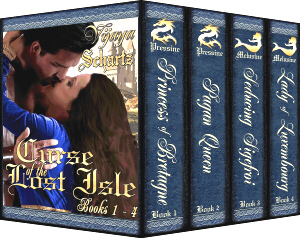
Brand new BOX SET for the Curse of the Lost Isle by Vijaya Schartz

Buy this kindle box set here

New Release: Curse of the Lost Isle box set. Wow! This one includes the first 4 novels in the Curse of the Lost Isle series for $5.00. Yep, my publisher decided they didn't want to play the $4.99 game anymore. 

From history shrouded in myths, emerges a family of immortal Celtic Ladies, who roam the medieval world in search of salvation from a curse... but if the Church ever suspects what they really are, they will be hunted, tortured, and burned at the stake.

This box includes: 
PRINCESS OF BRETAGNE - Book 1
PAGAN QUEEN - Book 2
SEDUCING SIGEFROI - Book 3
LADY OF LUXEMBOURG - Book 4

This is a chance to catch up with this 5-star edgy medieval fantasy romantic series. 

Book 5, Chatelaine of Forez - is also available in kindle
Book 6, Beloved Crusader is coming out this month!
Happy Reading!

Thursday, December 12, 2013

THE END! I finished Book 5 in the Curse of the Lost Isle series

Yep, I wrote THE END on the last page of the manuscript of CHATELAINE OF FOREZ, Book Five in the CURSE OF THE LOST ISLE series.

I'm going to polish it to a shine during the holidays, and send it to the publisher as soon as they reopen in January. Publication date will depend upon how long it takes the editors (some of them in England), and BWL's talented cover artists, to put it together. I predict it will probably be in late February or early March.

Anyhoo... I'm very excited and celebrating right now. Although this is my... let me count... Twenty-third title (I had to go to Amazon to check how many I had already published), the thrill of finishing a book never gets old.

CHATELAINE OF FOREZ follows Melusine (after Lady of Luxembourg) on a new adventure (still based upon the authentic legends, this time in the independent province of Forez (France), where I had a great time researching the local archives a few years ago.

Here is the short blurb:

Still afflicted by the ondine curse, Melusine seeks the reincarnated soul of her lost beloved in the young Artaud of Forez, who reigns over the verdant hills south of Burgundy, on the road of pilgrims, troubadours and merchants. But this dark and brooding Pagan lord is not at all what she hoped. He knows nothing of their past love, her Fae nature, or her secret curse. Must Melusine seduce and betroth this cold stranger to satisfy the Goddess and redeem her curse?

The gold in the rivers instills greed in the powerful, and many envy the rich Lord of Forez, including his most trusted vassals... even the Archbishop of Lyon. When a mythological creature is sighted in the swamps, initiating a holy hunt, will Melusine find redemption from the curse, or will she and Artaud burn at the stake?

Find the first four novels of the CURSE OF THE LOST ISLE in kindle on Amazon HERE
There is also a box set including the first three novels (best deal)