Showing posts with label Dark Ages. Show all posts

Friday, November 2, 2012

A Year of Omens by Joanna Fulford

The Anglo-Saxon Chronicle for the year 793AD states: “This year came dreadful fore-warnings over the land of the Northumbrians, terrifying the people most woefully: these were immense sheets of light rushing through the air, and whirlwinds, and fiery dragons flying across the firmament.  These tremendous tokens were soon followed by a great famine, and not long after, on the sixth day before the ides of January in the same year, the harrowing inroads of heathen men made lamentable havoc in the church of God in Holy-island by rapine and slaughter.” 
 
When they looked out across the North Sea on that fateful day in 793 and first glimpsed the approaching sail, the monks of Lindisfarne (Holy Island) had no idea of its significance.  Accounts of the event suggest they were taken completely by surprise and were unable to defend themselves against the onslaught of the Viking warriors.  Many of the monks were slain, others stripped and beaten before being driven off.  Everything of value was seized.  Holy books were burnt, crosses thrown down.  This incident heralded the beginning of numerous Viking incursions that were to plague the inhabitants of Britain for the next 250 years.
 

At first the Norsemen were content to conduct lightning raids in which they attacked vulnerable coastal settlements and carried off slaves, livestock and plunder.  However, the shallow draught of the Viking long ships meant that they were ideally suited for navigating rivers as well, and thus affording further opportunities for raiding parties to venture into the hinterland.  Having taken what they wanted they would retreat the same way.


Viking policy changed irrevocably in 865 AD.  This was the year of the Great Viking Invasion.  King Aella of Northumbria captured the famous Viking chief, Ragnar Lodbrok, and had him thrown into a pit of poisonous snakes.  When news of this evil deed reached them, Ragnar’s sons, Ingvar, Halfdan and Hubba, raised a huge fleet and set sail for Northumbria, seeking revenge for the death of their father.  In fact the fleet was blown off course and landed in East Anglia further down the English coast.  The crews looted the abbeys at Ely, Crowland and Peterborough where, it is alleged, Hubba killed seventy monks himself.  After this the army headed north, conquering much of Mercia and taking the city of York. 
 

Had the kingdom not been riven by internal factions fighting amongst themselves, the city might not have fallen.  As it was, the two petty kings, Aella and Osbert, were so preoccupied with jockeying for position that they failed to see the real peril.  By the time they came to their senses it was too late.  They raised an army and attempted to retake York.  The Anglo Saxon Chronicle tells us: “Then there was immense slaughter of Northumbrians, some within and some without (the city) and both the kings were slain on the spot.”  If Osbert died quickly he was fortunate.  When the Vikings executed Aella it took the form of the blood eagle sacrifice.  For good measure they threw salt into the wound as well.
 
The Viking army over-wintered in York but, when spring came, they didn’t depart for their overcrowded northern homeland.  England was a rich and fertile country and the Vikings saw their opportunity.  They stayed and settled and intermarried with the local population.  Eventually Northumbria became part of the vast region which was known as the Danelaw. 
 
These events form the background to my story The Viking’s Defiant Bride and its sequel The Viking’s Touch.  Quite apart from offering a dramatic external conflict, the period afforded numerous possibilities for strong emotional conflicts involving divided loyalties, and exploration of the relationship between the conqueror and the conquered. 
 
It was no hardship to undertake the necessary research for these books.  Northumbria is a beautiful and fascinating area, a magnet for anyone interested in history.  Lindisfarne is still a powerfully atmospheric place with a real sense of remoteness: the island can only be reached at low tide when the causeway is exposed to permit the passage of traffic.  When you stand among the ruins of the abbey and look out across the North Sea, it isn’t hard to imagine a striped sail on the horizon.


Saturday, October 6, 2012

More Light on the Dark Ages: the Staffordshire Hoard

After much eager anticipation I finally got to see the Staffordshire Hoard Exhibition this week.  Better still I didn’t have far to go.  Although the exhibition will travel to different parts of the country its permanent home will be in the Midlands where it was found.  Currently it’s on display at the Staffordshire Potteries Museum in Stoke.  For a writer with a keen interest in the Dark Ages it was too good an opportunity to miss.


Dark Age Warrior
In fact the story of the find might have come from a fantasy novel.  On the 5th July 2009 Terry Herbert went out with a metal detector on to farmland near Lichfield in Staffordshire.  He had, of course, obtained written permission from the landowner beforehand.   There Terry unearthed several gold objects.  Over the next five days he unearthed even more: 244 bags in all.  That’s about 11 kilos of gold. He reported his discovery to the Finds Liaison Officer for Staffordshire and the West Midlands.  What followed created huge excitement across the country, especially among archaeologists and Dark Age historians.
 
 
Millifiori stud
The hoard dates from between 650-700AD and it contains approximately 3000 artefacts.  At present 250 of these are on display.  The find is unusual in that almost all the objects in it are military in nature: sword pommels, seax handles, buckles, shield bosses, harness mountings and helmet fragments.  There is also a magnificent gold cross and a gold belt bearing a Latin inscription.  What stands out is the beauty and quality of the craftsmanship involved in making these things.  Their original owner or owners were people of high status: kings, princes or noblemen.  These items were designed to display rank and wealth and only the richest could have afforded them.  In today’s values they’re worth about £2 ½ million.  In many ways they are reminiscent of the artefacts found at Sutton Hoo, about which I wrote in a previous blog.


Sword pommel
The gold is exquisitely crafted and inlaid with garnets in geometric patterns.  Each component cell is lined with gold foil so that light is reflected back through the stone.  Sometimes the garnet inlay is contrasted with pieces of Roman tile, cunningly cut down and re-used in an early example of recycling. Neither the metal nor the gems in the hoard originated in England.  The gold came from Byzantium, the garnets from India.  Once again they point to an extensive and sophisticated trading network stretching across Europe and the Middle East to the Far East.

 
Belt with inscription
It is thought that the hoard may have been battle loot.  Staffordshire was once part of the ancient and powerful kingdom of Mercia which, back then, was undergoing great political upheaval.  Armed conflicts were frequent.  We don’t know who amassed and buried the hoard or why, but it seems likely it was done at a time of crisis.  Nevertheless, whoever it was never came back for it.  In consequence it lay undiscovered for 1300 years.

 
The sheer size of the find makes it unlikely that it will all be shown together, although I imagine we will eventually see an exhibition on a larger scale than the present one.  Nevertheless, this one is pretty amazing and I wouldn’t have missed it.  The experience reinforces my opinion that, although the Dark Ages saw plenty of conflict, it was not peopled by ignorant and primitive barbarians.  I also think that, before too long, similar discoveries will be made which will add to our understanding of the period.
 

Wednesday, August 1, 2012

A Little Light on the Dark Ages by Joanna Fulford


The Dark Ages (broadly 500–1000AD) was a period marked by frequent warfare and the virtual disappearance of urban life.  It followed the collapse of the Western Roman Empire.  When the legions left Britain in 410AD, their absence created an opportunity for invading tribes of Jutes, Angles, Saxons and Friesians who competed for land and power.  It was the era of Bede and Hilda and Cuthbert, and the legendary king called Arthur about whom so much has been written.

The period is described as ‘dark’ because we know relatively little about it.  The surviving evidence is thin on the ground.  And yet what does remain offers a glimpse of something tantalising and at variance with preconceived notions about intellectual darkness and barbarity.


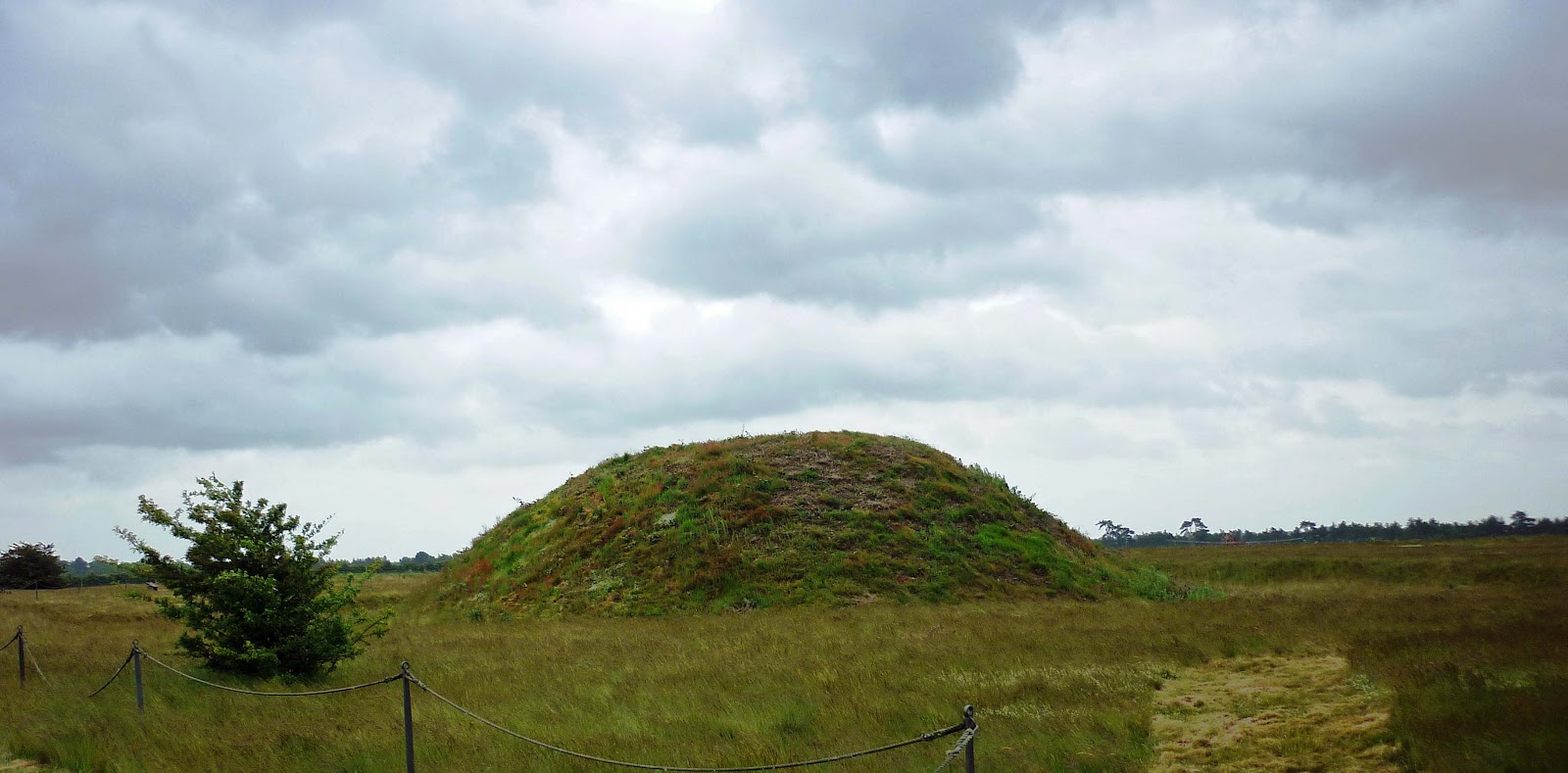
Burial mound


On my recent research trip into Suffolk (see previous blog) one of the places I visited was Sutton Hoo.  It’s a must-see for anyone interested in the early medieval period.  My visit coincided with an anticyclone, but storm winds and driving rain added another dimension to the sombre beauty of this ancient Saxon burial ground.  There are several burial mounds at Sutton Hoo, but the largest and most famous is believed to be that of the mighty East Anglian king called Raedwald who died around 625AD.  Excavation of the grave revealed the outline of a great ship.  The timbers have long since decayed in the region’s acid soil but a host of other artefacts remain.  These range from weapons and armour to coins and cauldrons; cups and gaming pieces.  Most astonishing of all is the beauty and craftsmanship of the jewellery.  The originals are in the British Museum in London, but the exhibition centre at Sutton Hoo has excellent replicas.  As soon as I saw these, a lot of preconceived ideas about ignorant Dark Age barbarians went up in smoke.

Sutton Hoo helmet
belt buckle


There is nothing remotely primitive about these fabulous pieces, and the hand that made them belonged to a master craftsman using techniques that have changed very little since.  The level of sophistication involved is self-evident.  Stunning design is used throughout.  Sword and belt fittings, purse lid and shoulder clasps all reveal it.  Into the glorious gold settings the goldsmith set red stones: rubies brought from India; garnets from Northern Europe.   He cut and shaped them and then set them into miniature cells of gold, each backed with gold foil to reflect the light through the gem.  The stepped interlocking patterns were built up with geometric precision and balance.  In some instances the design is freer and represents interlaced creatures and protective animal, bird and man-like figures depicting a visual language once widely understood in Northern Europe but whose meaning is now obscure.  Each piece is a work of art in its own right and speaks volumes about the power and status of the king for whom it was made.  In modern values, the equivalent cost of recreating the shoulder clasps alone is estimated to be in the region of £100,000 – roughly $156.000.  Yet they were just a small part of Raedwald’s treasure.

Purse lid
The king’s sword had a superb blade forged by a highly skilled pattern welder.  One of the three hanging bowls discovered in the grave carried brightly enamelled and patterned fittings of Celtic design.  Silver dishes, bowls and spoons reveal Roman and Byzantine production.  One of the bowls came from North Africa.  Excavations of cemeteries in central Sweden reveal ship-burial customs and contain helmets and shields very like those from the Sutton Hoo ship.   King Raedwald, and rulers like him, belonged to an international culture in which the sea was not a barrier but a path of communication.

Shoulder clasps
Sutton Hoo has provided valuable insights into the past and has caused me to re-evaluate the Dark Ages.  Certainly the departure of the Roman legions from Britain had a profound effect and, yes, it was a period of warfare and invasion.  However, it seems to me that that isn’t the whole story.  I can’t buy into the idea that Britain and Europe and this time were inhabited solely by mindless barbarians: the existing evidence suggests something very different. 

The Dark Ages continue to fascinate us: I come back to an earlier point about the sheer volume of stories written about Arthurian legend.  Perhaps our love affair with the period is partly concerned with its obscurity; with not knowing for sure; with the continual exercise of the imagination.  Perhaps too it is about those occasional gleams of light when an enthusiast with a metal detector unearths another hoard of ancient treasure and suddenly our understanding of the past alters dramatically.  For the novelist such moments are pure gold.

I’d love to hear about your light-bulb moments. What was it that changed your perception of the past or provided you with fresh insight?