Showing posts with label England. Show all posts

Friday, July 26, 2013

A few lines from "His Shadowed Heart" by Hazel Statham


here are a few lines from:
HIS SHADOWED HEART
by Hazel Statham

From Books We Love
http://amzn.com/B00AWBHHDU

Can a shadowed heart be healed? Can love grow where least expected? The Earl of Waverly believes not. How wrong can he be!

After the death of his wife, the Earl of Waverly, believing his heart irreparably damaged, enters into a marriage of convenience. However, he is not prepared for the healing influence his new young bride has on his life. Despite the couple’s new-found happiness, nefarious deeds abound and strange happenings are attributed to the ghost of his former wife. Will their love stand the test or will the perpetrator emerge the victor?

Excerpt:

Taking a branch of candles that had been prepared for his use from the small table set at the base of the staircase, he started up the stairs, finding it necessary to make light use of the rosewood banister to steady his progress.

Traversing the long corridor to his bedchamber, he paused momentarily outside his wife’s door, but as no light shone from beneath, he continued on to his own apartment. Closing the door quietly behind him he paused in the center of the room. All was in darkness except for the pool of light cast by the candles he held and for a moment, their flickering caught the handle to the connecting door. Yielding to an irresistible temptation, he pressed the handle, and finding no resistance there, entered the chamber.

As in his own room, all was in darkness. Turning to where he knew the bed to be, he raised the candles higher so that their glow spread across the room, illuminating the sleeping figure there. Crossing to the bed, he knelt at her side and extinguishing all but one of the flames, placed the candelabra on a small table at the side of the bed.

The shadows of the remaining light played across Caroline’s sleeping form and he smoothed a lock of hair that had strayed across her forehead. He knew the desire that his lips should follow his finger’s course, but even in his state of inebriation, he knew this would be foolish.

For several minutes, he watched his wife sleep, eventually placing his head upon the pillow beside her. His lips curved into a loving smile as his eyes drank in her sleep-softened countenance, and he felt her breath caress his cheek. The longing to hold her became an almost physical thing and his arms ached with the suppressed desire.

Eventually she stirred, muttering incoherently in her sleep, and he raised himself up. What foolishness is this, he thought. I am acting like a callow youth. Immediately he was on his feet. Snatching up the light, he went quickly out of the room, closing the door quietly behind him.

Wednesday, August 1, 2012

A Little Light on the Dark Ages by Joanna Fulford


The Dark Ages (broadly 500–1000AD) was a period marked by frequent warfare and the virtual disappearance of urban life.  It followed the collapse of the Western Roman Empire.  When the legions left Britain in 410AD, their absence created an opportunity for invading tribes of Jutes, Angles, Saxons and Friesians who competed for land and power.  It was the era of Bede and Hilda and Cuthbert, and the legendary king called Arthur about whom so much has been written.

The period is described as ‘dark’ because we know relatively little about it.  The surviving evidence is thin on the ground.  And yet what does remain offers a glimpse of something tantalising and at variance with preconceived notions about intellectual darkness and barbarity.


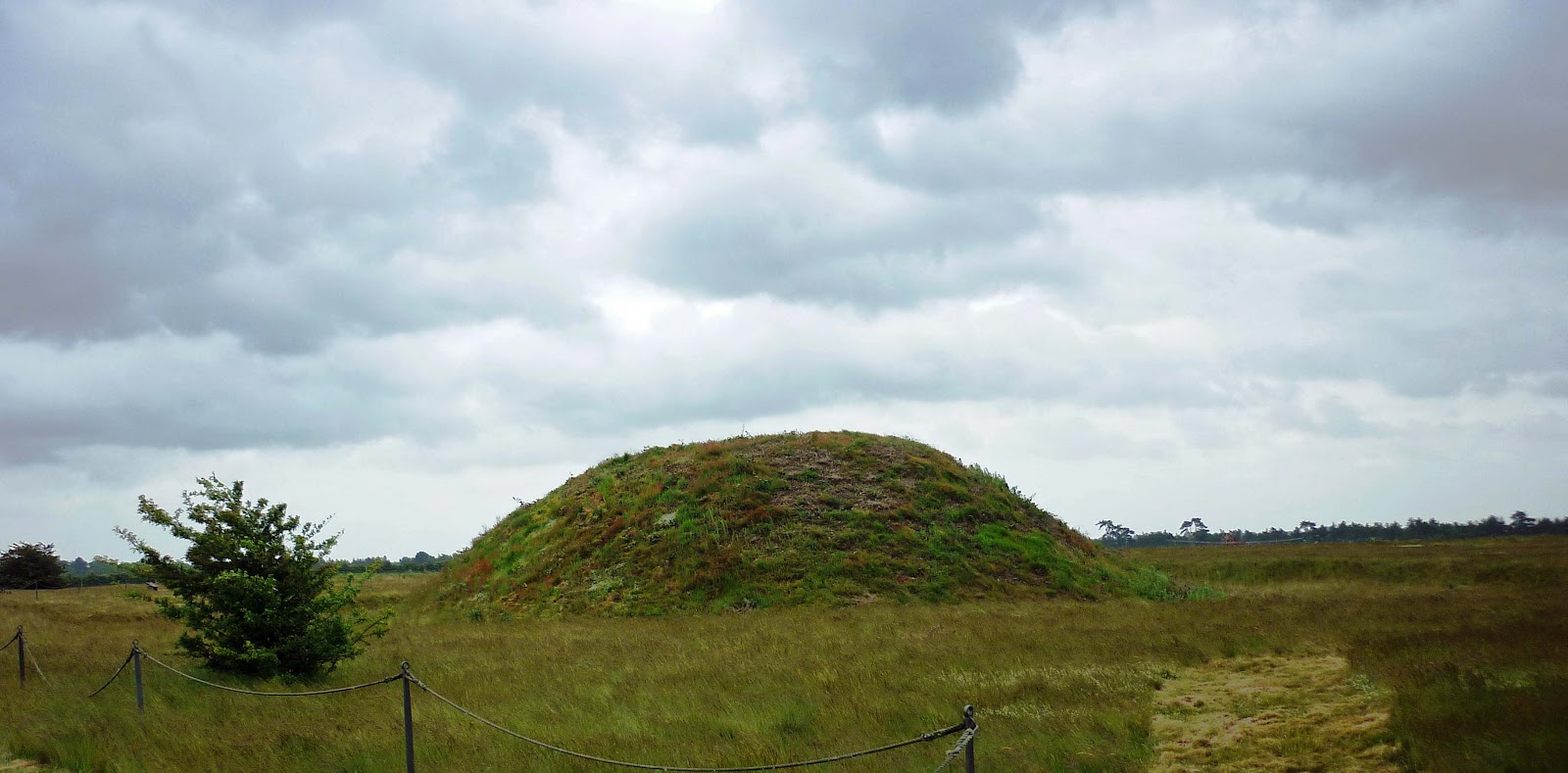
Burial mound


On my recent research trip into Suffolk (see previous blog) one of the places I visited was Sutton Hoo.  It’s a must-see for anyone interested in the early medieval period.  My visit coincided with an anticyclone, but storm winds and driving rain added another dimension to the sombre beauty of this ancient Saxon burial ground.  There are several burial mounds at Sutton Hoo, but the largest and most famous is believed to be that of the mighty East Anglian king called Raedwald who died around 625AD.  Excavation of the grave revealed the outline of a great ship.  The timbers have long since decayed in the region’s acid soil but a host of other artefacts remain.  These range from weapons and armour to coins and cauldrons; cups and gaming pieces.  Most astonishing of all is the beauty and craftsmanship of the jewellery.  The originals are in the British Museum in London, but the exhibition centre at Sutton Hoo has excellent replicas.  As soon as I saw these, a lot of preconceived ideas about ignorant Dark Age barbarians went up in smoke.

Sutton Hoo helmet
belt buckle


There is nothing remotely primitive about these fabulous pieces, and the hand that made them belonged to a master craftsman using techniques that have changed very little since.  The level of sophistication involved is self-evident.  Stunning design is used throughout.  Sword and belt fittings, purse lid and shoulder clasps all reveal it.  Into the glorious gold settings the goldsmith set red stones: rubies brought from India; garnets from Northern Europe.   He cut and shaped them and then set them into miniature cells of gold, each backed with gold foil to reflect the light through the gem.  The stepped interlocking patterns were built up with geometric precision and balance.  In some instances the design is freer and represents interlaced creatures and protective animal, bird and man-like figures depicting a visual language once widely understood in Northern Europe but whose meaning is now obscure.  Each piece is a work of art in its own right and speaks volumes about the power and status of the king for whom it was made.  In modern values, the equivalent cost of recreating the shoulder clasps alone is estimated to be in the region of £100,000 – roughly $156.000.  Yet they were just a small part of Raedwald’s treasure.

Purse lid
The king’s sword had a superb blade forged by a highly skilled pattern welder.  One of the three hanging bowls discovered in the grave carried brightly enamelled and patterned fittings of Celtic design.  Silver dishes, bowls and spoons reveal Roman and Byzantine production.  One of the bowls came from North Africa.  Excavations of cemeteries in central Sweden reveal ship-burial customs and contain helmets and shields very like those from the Sutton Hoo ship.   King Raedwald, and rulers like him, belonged to an international culture in which the sea was not a barrier but a path of communication.

Shoulder clasps
Sutton Hoo has provided valuable insights into the past and has caused me to re-evaluate the Dark Ages.  Certainly the departure of the Roman legions from Britain had a profound effect and, yes, it was a period of warfare and invasion.  However, it seems to me that that isn’t the whole story.  I can’t buy into the idea that Britain and Europe and this time were inhabited solely by mindless barbarians: the existing evidence suggests something very different. 

The Dark Ages continue to fascinate us: I come back to an earlier point about the sheer volume of stories written about Arthurian legend.  Perhaps our love affair with the period is partly concerned with its obscurity; with not knowing for sure; with the continual exercise of the imagination.  Perhaps too it is about those occasional gleams of light when an enthusiast with a metal detector unearths another hoard of ancient treasure and suddenly our understanding of the past alters dramatically.  For the novelist such moments are pure gold.

I’d love to hear about your light-bulb moments. What was it that changed your perception of the past or provided you with fresh insight?

Saturday, May 12, 2012

Medieval Romance and Paranormal Suspense - by JoAnn Smith Ainsworth

When I carried wood as a pre-teen so my Great Aunt Martha could stoke up the iron stove to prepare dinner, I wasn't thinking, "I could use this in a novel someday." Yet almost 60 years later, the skills I learned from my horse-and-buggy ancestors translate into backdrops for my historical romance novels. Growing up with paternal grandparents born in the 1890's made creating historical novels a logical choice.

MIDDLE AGES HOMES AND GRANDPARENTS’ 1880’S HOMES HAD A LOT IN COMMON

When I carried wood as a pre-teen so my Great Aunt Martha could stoke up the iron stove to prepare dinner, I wasn’t thinking, “I could use this in a novel someday.” Yet, the skills I learned from my horse-and-buggy ancestors translate into backdrops for my medieval romantic suspense novels. Until doing research, I didn't realize how many cooking and household tools and utensils were still in use at the turn of the 20th century which were similar to those in use in the Middle Ages.

  • The biggest surprise was the grinding wheel. My grandfather had one in the garage to sharpen knives. I found the only modern difference was that my grandfather’s wheel had a section of rubber tire to hold water to wet the stone.

  • My great aunt used wooden spoons for cooking and pewter platters for serving. She dried her long hair in the sun or in front of the fire. Chamber pots were under the bed and the outhouse was down the path.

  • Ceramic basins in bedrooms were filled from pitchers of warmed water brought upstairs from the kitchen. A washcloth and sudsy water in a basin were used for daily bathing. The Saturday night bath was in the metal washtub and set up in the kitchen to be close to the water boiled on the cooking stove and the only source of running water inside the house. (My great aunt had a hand pump outside.) The kitchen location for the washtub also made it easier to drain the water afterward.

  • My great aunt had a root cellar dug into the ground which kept her stored foods at a cool temperature. Berries and nuts were gathered from the woods and canned or dried to eat during the winter. Throw rugs were draped over the clothesline and the dirt beat out of them periodically with a wire carpet beater.

  • She made her own starch and the lye soap for doing the laundry. A metal iron was heated on the wood-burning stove before ironing her clothes.

  • The local farmers brought to the door, freshly slaughtered meat or harvested fruits and vegetables. Life was at a much slower pace.

Those days are gone and that's fine by me. Hanging heavy, soaking, dripping wash on the clothesline in the cold of winter with my fingers freezing to the clothespins was not my cup of tea. The backbreaking work tending a vegetable garden and farm animals was also not for me. A well-stocked grocery store suits me just fine.

What I got from those times spent with my grandparents’ generation and was a sense of their daily lives before technology. No plastic, no vacuum cleaners, no wash machines and dryers, no t.v., no phones, no box stores, no cars, no jet planes, no Internet.

I transfer those intimate details into my manuscripts. By doing so, I create for you the experience of medieval times just by reading MATILDA'S SONG and OUT OF THE DARK.

Enjoy.

JoAnn Ainsworth (www.joannsmithainsworth.com

Friend me on Facebook and follow me on Twitter.
Duty requires sacrifice…but the heart will not be denied

At the time, pretending marriage to her middle-aged widower cousin seemed like the best way to escape a politically motivated betrothal to a brutal knight. Now, her journey toward a new life has landed her in hot water—she’s been waylaid by a local Norman baron who’s mistaken her for a real bride. And he demands First Night rights.

Hot water turns to steam in a scalding night of passion…passion she has never known. And now must live without.

Lord Geoffrey is entranced at first sight of the Anglo-Saxon beauty and finds that one night in her arms is not nearly enough. But all he can offer the low-born Matilda is a life in the shadows—as his mistress.


Back Cover Blurb OUT OF THE DARK ISBN: 978-1-60504-277-0

Blinded—she by nature, he by loyalty.

As a blind woman seen as a flawed commodity, Lady Lynnet is used to the idea that she's unlovable. But her parents' plan to force her into a loveless marriage is too much. Wandering, upset and lost in the cellars of the king's castle, the darkness doesn't frighten her, but the murder plot she overhears chills her to the bone. Worse, no one believes her, and the only one she can turn to is a Norman sheriff whose voice sounds disturbingly like one of the conspirators.

Basil, Sheriff of London, is battle-hardened, fiercely loyal—and torn apart. He's falling in love with the Saxon beauty, and he longs to show her she is worthy of love despite her physical limitation.

But the very corruption she is helping him root out may implicate his own half brother. How can he turn his back on family—for an Anglo-Saxon woman?


Check out JoAnn’s website. http://joannsmithainsworth.com/novels.shtml

Follow her on Facebook and Twitter.