Showing posts with label Raedwald. Show all posts

Monday, September 3, 2012

West Stow: An Insight Into Anglo Saxon Life

The Dark Ages create numerous problems for writers.  Accounts from the time are few and often written at second hand.  The remaining physical evidence is scant.  That’s why reconstruction can be so useful.  The Anglo-Saxon village at West Stow is a case in point.  It’s situated in the Lark Valley in Suffolk.  This county is part of East Anglia, once the dominant kingdom of England under King Raedwald.  (He featured in my previous blog on Sutton Hoo.)  It was also part of a much wider European culture.

West Stow Saxon village

    West Stow reveals much about the early Anglo Saxons in the period from 420-650AD.  The village has been recreated on the site where it was originally excavated, using the available archaeological evidence to determine the design and materials used.  Inevitably, experimental archaeology involves an element of best guess as well as trial and error.  For that reason the buildings are not uniform.  Some are constructed of timber, whereas others feature walls of wattle and daub.  One house has an earthen floor, a design that was abandoned when further excavations revealed evidence of the existence of wooden floor boards.  Consequently, subsequent houses incorporated these.  The houses also feature windows with weatherproof shutters, and stout wooden doors that can be securely fastened from inside.  Roofs are made of reed or straw thatch.  Taken as a whole they offer a real insight into the lives of Anglo Saxon people at the time.


door locking mechanism

weaving loom


Most of the structures are remarkably sophisticated and there is painstaking attention to detail.  This is also reflected in the simple furnishings inside each of the buildings whether it’s a box bed, a door latch, a loom or a bucket.  In addition to the various dwellings there is a barn and also a central hall.  The latter is modest in comparison to some of the great halls of the later Saxon period (like the magnificent example created by Regia Anglorum near Canterbury in Kent) but it serves a similar function.  Apart from offering additional sleeping accommodation in time of need, it was a focal point, serving both as a meeting place and also for entertainment, perhaps the telling of stories round the hearth of a winter night, or the relation of news from traders and travellers.  West Stow also boasts a carpenter’s shop as well as a forge and a kiln.  There are pig sties too complete with occupants, a cross breed of the ancient Tamworth with wild boar.  It is thought that pigs in Anglo Saxon times were originally descended from Iron Age stock.  People also kept cattle and sheep.  The river provided fish and fowl, the forest deer and boar.  There is also evidence of hens, geese and goats as well as domestic animals like cats and dogs.


crop growing
West Stow demonstrates the types of crops grown during the Anglo Saxon period: spelt wheat, barley, oats, rye, peas, beans, white carrots, kale and numerous herbs.  Back then the acreage of crops would have been much larger to maximise food production and thus see the community through the winter and also the lean months before the next harvest.  However, the existing area under cultivation gives a clear impression of what was grown and the surprisingly varied nature of the diet.


The village was virtually self-sufficient though excess crops could be used to barter for ornaments and trinkets from travelling traders.  Large towns were then unknown.  The scenery would also have been very different since the land was not enclosed and the big skies for which East Anglia is renowned would have seemed even greater.


different building styles
Writing about the Dark Ages is always an exercise of the imagination, but reconstructions like the one at West Stow really do provide some wonderful insights.  I’ve used the knowledge gleaned here to inform the stories that are set at a slightly later period.  For instance The Viking’s Defiant Bride and The Viking’s Touch both draw on this information and extrapolate from it.  Information about these and my other books can be found on my website at www.joannafulford.co.uk 


What historical locations have offered you the greatest insights?  I’d be interested to know.


Wednesday, August 1, 2012

A Little Light on the Dark Ages by Joanna Fulford


The Dark Ages (broadly 500–1000AD) was a period marked by frequent warfare and the virtual disappearance of urban life.  It followed the collapse of the Western Roman Empire.  When the legions left Britain in 410AD, their absence created an opportunity for invading tribes of Jutes, Angles, Saxons and Friesians who competed for land and power.  It was the era of Bede and Hilda and Cuthbert, and the legendary king called Arthur about whom so much has been written.

The period is described as ‘dark’ because we know relatively little about it.  The surviving evidence is thin on the ground.  And yet what does remain offers a glimpse of something tantalising and at variance with preconceived notions about intellectual darkness and barbarity.


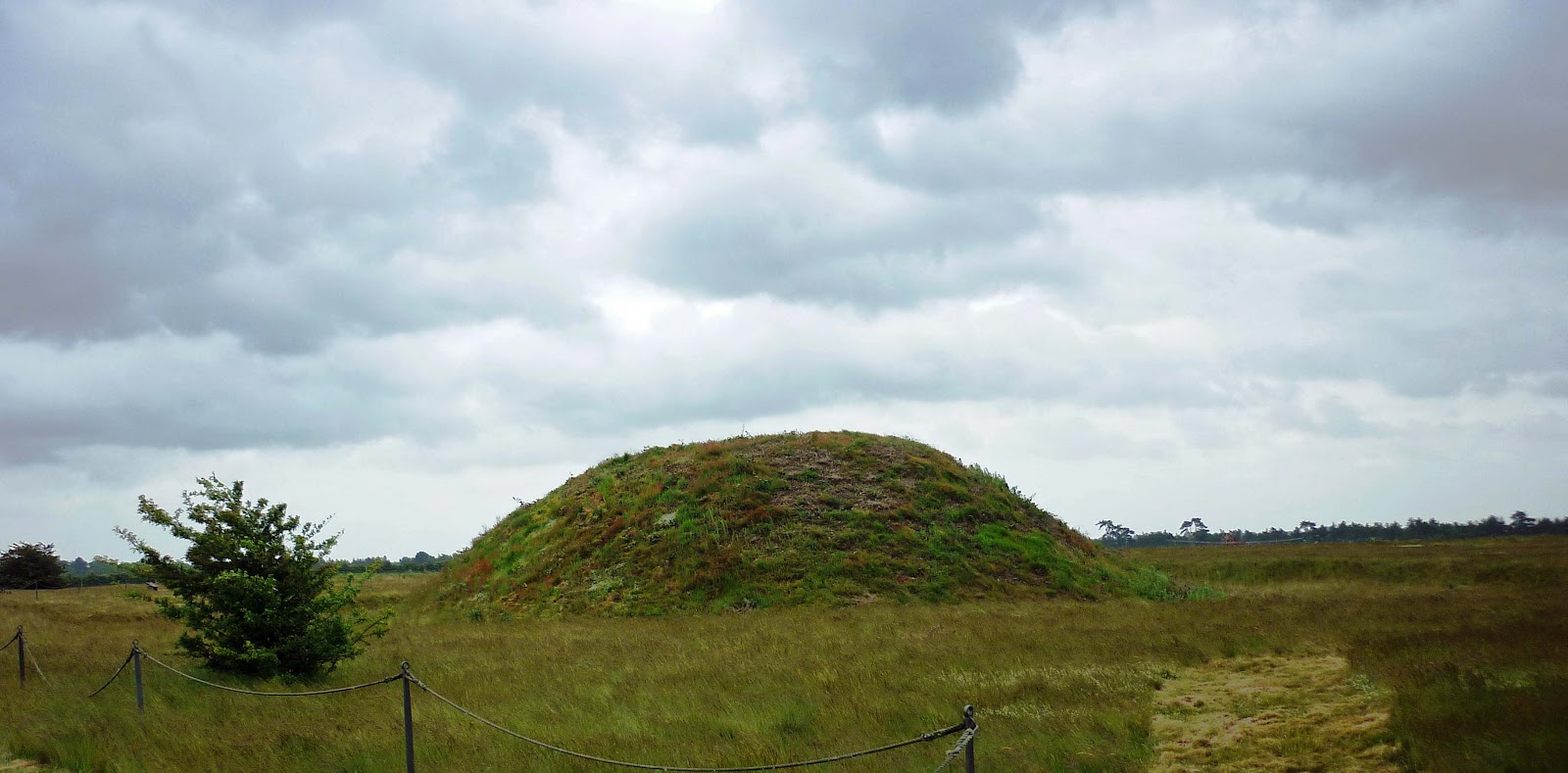
Burial mound


On my recent research trip into Suffolk (see previous blog) one of the places I visited was Sutton Hoo.  It’s a must-see for anyone interested in the early medieval period.  My visit coincided with an anticyclone, but storm winds and driving rain added another dimension to the sombre beauty of this ancient Saxon burial ground.  There are several burial mounds at Sutton Hoo, but the largest and most famous is believed to be that of the mighty East Anglian king called Raedwald who died around 625AD.  Excavation of the grave revealed the outline of a great ship.  The timbers have long since decayed in the region’s acid soil but a host of other artefacts remain.  These range from weapons and armour to coins and cauldrons; cups and gaming pieces.  Most astonishing of all is the beauty and craftsmanship of the jewellery.  The originals are in the British Museum in London, but the exhibition centre at Sutton Hoo has excellent replicas.  As soon as I saw these, a lot of preconceived ideas about ignorant Dark Age barbarians went up in smoke.

Sutton Hoo helmet
belt buckle


There is nothing remotely primitive about these fabulous pieces, and the hand that made them belonged to a master craftsman using techniques that have changed very little since.  The level of sophistication involved is self-evident.  Stunning design is used throughout.  Sword and belt fittings, purse lid and shoulder clasps all reveal it.  Into the glorious gold settings the goldsmith set red stones: rubies brought from India; garnets from Northern Europe.   He cut and shaped them and then set them into miniature cells of gold, each backed with gold foil to reflect the light through the gem.  The stepped interlocking patterns were built up with geometric precision and balance.  In some instances the design is freer and represents interlaced creatures and protective animal, bird and man-like figures depicting a visual language once widely understood in Northern Europe but whose meaning is now obscure.  Each piece is a work of art in its own right and speaks volumes about the power and status of the king for whom it was made.  In modern values, the equivalent cost of recreating the shoulder clasps alone is estimated to be in the region of £100,000 – roughly $156.000.  Yet they were just a small part of Raedwald’s treasure.

Purse lid
The king’s sword had a superb blade forged by a highly skilled pattern welder.  One of the three hanging bowls discovered in the grave carried brightly enamelled and patterned fittings of Celtic design.  Silver dishes, bowls and spoons reveal Roman and Byzantine production.  One of the bowls came from North Africa.  Excavations of cemeteries in central Sweden reveal ship-burial customs and contain helmets and shields very like those from the Sutton Hoo ship.   King Raedwald, and rulers like him, belonged to an international culture in which the sea was not a barrier but a path of communication.

Shoulder clasps
Sutton Hoo has provided valuable insights into the past and has caused me to re-evaluate the Dark Ages.  Certainly the departure of the Roman legions from Britain had a profound effect and, yes, it was a period of warfare and invasion.  However, it seems to me that that isn’t the whole story.  I can’t buy into the idea that Britain and Europe and this time were inhabited solely by mindless barbarians: the existing evidence suggests something very different. 

The Dark Ages continue to fascinate us: I come back to an earlier point about the sheer volume of stories written about Arthurian legend.  Perhaps our love affair with the period is partly concerned with its obscurity; with not knowing for sure; with the continual exercise of the imagination.  Perhaps too it is about those occasional gleams of light when an enthusiast with a metal detector unearths another hoard of ancient treasure and suddenly our understanding of the past alters dramatically.  For the novelist such moments are pure gold.

I’d love to hear about your light-bulb moments. What was it that changed your perception of the past or provided you with fresh insight?