Thursday, February 28, 2013

Other medieval stories - Janet Lane Walters


LINES OF FIRE
The Guild House - Defenders' Hall
by Janet Lane Walters

To honor a promise made to his dying father, Alric trains as a Defender. For some reason the Swordmaster wishes him gone and his first two bondings end in failure. A failed third one will see  Alric banished. His meeting with the older daughter of the Swordmaster reveals a double heart bond, but she has been promised to Petan, the Swordmaster's favorite. A duel is fought and  though Alric can read Petan's lines of fire, the other dueler cheats and nearly kills Alric. Petan is  banished but he knows secret ways into Defenders Hall. Kalia, his now bondmate's lines are  tarnished. Not only do Alric and Kalia need to find Petan, they must learn how to cleanse her lines.

You can buy the book here: 

You can find the author here:

Saturday, January 19, 2013

Lady of Luxembourg has a kick-ass cover - by Vijaya Schartz


This is a first peek at the cover of LADY OF LUXEMBOURG, Book 4 in the Curse of the Lost Isle medieval series. The artist is Michelle Lee, and she designed it for Books We Love. I absolutely love it. My heroine is depicted as Fae, strong, and wielding magic. Also love the sword with the mermaid. The sword runs through all the covers in the series, but the first two books had a dragon, and since this heroine is an ondine (she transforms into a mermaid on specific days), it keeps the theme running.

Fire is also a strong element in this particular novel. The fires of hell, the threat of being burned at the stake, and the magic fire Melusine wields in the service of the Pagan Goddess she worships.

I hope you like the cover as much as I do. I did have some input in this cover and I am very grateful my publisher is allowing me to participate to this degree.

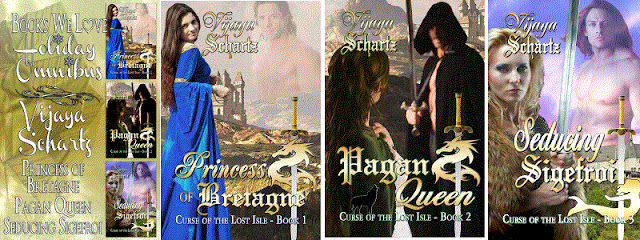
The book should be out in kindle in a few days. In the meantime, don't forget to re-read or read the first three books, PRINCESS OF BRETAGNE, PAGAN QUEEN, and SEDUCING SIGEFROI. You can find them all in kindle at AMAZON


Happy Reading!

Vijaya Schartz
Blasters, Swords, Romance with a Kick

Friday, January 11, 2013

Free book - free contest - Curse of the Lost Isle by Vijaya Schartz

Don't miss free today in kindle, for the very last time, the first three novels of the CURSE OF THE LOST ISLE series in one download at: http://amzn.com/B0091HX7EE


Curse of the Lost Isle series: 5-stars
Special Edition - Princess of Bretagne, Pagan Queen, and Seducing Sigefroi

Book 4, LADY OF LUXEMBOURG, is in the last editing stages and will be out this month. I'm very excited about it. ENTER MY CONTEST TO WIN LADY OF LUXEMBOURG as soon as it is published at:

This series received many 5-star reviews from professionals and was called edgy, bloody, unique, and fast-paced, with battle scenes, love scenes, gorgeous flawed heroes and strong, immortal, but also flawed heroines.

Now I have to clear my desk from all the research papers, books and pictures on the foundation of Luxembourg, and move on to something else. But I'm not sad, because this series has many more books to come, and I'll be back writing it very soon. Book 5 in this exciting series, set in Forez (between the Rhone and Loire rivers) in the eleventh century, is tentatively titled CHATELAINE OF FOREZ, but this is only a working title. That book should be released at the end of this year.

For the next three months, I'll be writing a sci-fi romance novella in the BOREALIS universe for another publisher (Desert Breeze) with whom I only publish sci-fi romance.

In the meantime, you can find all my eBooks and paperbacks at all major online retailers:

AMAZON  -  B&N  -  KOBO  -  APPLE  -  SONY  -  SMASHWORDS  -  and many more.

HAPPY READING
Vijaya Schartz
Romance with a Kick

You can find out more about Vijaya Schartz and her books at:
On Twitter: @vijayaschartz
On Facebook:

Sunday, January 6, 2013

1066: The Action Replay by Joanna Fulford


Saturday 14th October 1066 is the date of Battle of Hastings, one of  the most momentous events in English history. On that day the Anglo Saxon army, under the leadership of King Harold, was defeated by a force of Normans, Flemings and Bretons led by Duke William of Normandy, later to be crowned King William I of England.


Every year, to mark the anniversay, there is a re-enactment of the battle, held on the hill just outside Battle Abbey.  For a lover of early medieval history it's a must-see event.  Unsurprisingly, it attracts visitors from far and wide.  However, anyone anticipating medieval-style carnage is doomed to disappointment: slaying people (even the French) is forbidden, and bloodshed and mutilation are also discouraged.   Even so, when several hundred individuals are swinging swords and axes accidents sometimes happen.  Broken fingers and bruises are the most common injuries.  No doubt it hurts, but it seems fairly trivial when you think about what happened to King Harold.
 
 
Despite the lack of gore, what this event does offer is a real insight into the conduct of the battle, which, at two distinct points, could have gone either way.  With the benefit of 20:20 hindsight you'd think the Anglo Saxon army would have learned from past mistakes but they never do.  The Normans win every year.  Nevertheless, the atmosphere is astonishing.  When the Norman cavalry comes charging up the hill towards the Saxon shield wall, the ground shakes under the horses' hooves and air reverberates with the battle cries of the opposing armies.  I promise you, it raises all the hairs on the back of the neck.


Much as I enjoy the re-enactment of the battle, the most valuable aspect of the whole experience is the time spent walking round the encampment speaking to individual re-enacters.  Their passion for the period is immediately apparent and their knowledge and skills impressive.  They are a friendly crowd and are also generous with their time.   As a result I have learned an enormous amount: everything from making chain mail and scabbards to turn shoes and medicines.  For this I am sincerely grateful and, where possible, I incorporate the information into my stories to strengthen the period detail.

My only reservation about the Battle of Hastings re-enactment is concerned with the location.  I suspect it's not the site of the actual battle.  First, the topography doesn't agree with surviving accounts of the event.  I know it was a thousand years ago and landscapes can change dramatically in that time, but there are still inconsistencies that are hard to explain away: the absence of the Malfosse for instance.  This is the ravine where, we're told, the Saxons fought a fierce rearguard action and killed a large number of the French.   Secondly, there's the total absence of archaeological evidence.  Accounts vary about the numbers involved in the battle: anywhere up to 15,000 men in all.  Yet successive digs on the site have failed to uncover any remains.  The reason given up till now is acid soil which, it is claimed, has eroded everything.  That raises questions, in my mind anyway.  Consider the Staffordshire Hoard and the magnificent relics exacavated at Sutton Hoo.  Those treasures had all lain in acid soil and survived and they predate Hastings by 400 years.  The Staffordshire Hoard alone comprises over 3000 items.  Yet not one relic of a large-scale conflict remains at the alleged site at Hastings: not a rusting sword blade, shield boss, scabbard or harness mount, fragment of chain mail, spur or horse shoe.  To me, that doesn't add up.  If nothing has been found I suspect it's because people are digging in the wrong place.  There's another hill, not far from the present re-enactment site, which is a possible candidate for the true battlefield.  It would be interesting to see what an archaeological dig there might uncover.

Friday, November 16, 2012

Cursed Lady of Luxembourg - by Vijaya Schartz

A cursed immortal lady, a gorgeous knight, medieval fortresses, enraged bishops, sightings of ondines in the rivers... and if the lady is caught in mermaid shape or discovered as an immortal... the consequences will be dire. For her, and for those she loves.

The dangers never discouraged Melusine of Luxembourg, especially when she has the support of her beloved count, Sigefroi. But she never ages, and the Church is watching...

Betrayed in battle, Sigefroi reflects on his many sins from the depths of a rat infested dungeon. Under torture, will he reveal her deadly secret? When her protector turns religious, what is a Fae to do?

As destiny never relents, can Melusine salvage her happiness? Can love truly redeem her curse?  Or will she burn at the stake?

Lady of Luxembourg, Book 4 in the Curse of the Lost Isle medieval fantasy series, is coming soon from Books We Love. Don't miss this gritty historical romantic series. The first three novels are available in a special set for a very attractive price:
http://amzn.com/B0091HX7EE

All previous titles are also available individually with all my other kindle titles HERE


Vijaya Schartz
Swords, Blasters, Romance with a kick
http://www.vijayaschartz.com

Find my books on AMAZON - B&N - ARE - SMASHWORDS

Friday, November 2, 2012

A Year of Omens by Joanna Fulford

The Anglo-Saxon Chronicle for the year 793AD states: “This year came dreadful fore-warnings over the land of the Northumbrians, terrifying the people most woefully: these were immense sheets of light rushing through the air, and whirlwinds, and fiery dragons flying across the firmament.  These tremendous tokens were soon followed by a great famine, and not long after, on the sixth day before the ides of January in the same year, the harrowing inroads of heathen men made lamentable havoc in the church of God in Holy-island by rapine and slaughter.” 
 
When they looked out across the North Sea on that fateful day in 793 and first glimpsed the approaching sail, the monks of Lindisfarne (Holy Island) had no idea of its significance.  Accounts of the event suggest they were taken completely by surprise and were unable to defend themselves against the onslaught of the Viking warriors.  Many of the monks were slain, others stripped and beaten before being driven off.  Everything of value was seized.  Holy books were burnt, crosses thrown down.  This incident heralded the beginning of numerous Viking incursions that were to plague the inhabitants of Britain for the next 250 years.
 

At first the Norsemen were content to conduct lightning raids in which they attacked vulnerable coastal settlements and carried off slaves, livestock and plunder.  However, the shallow draught of the Viking long ships meant that they were ideally suited for navigating rivers as well, and thus affording further opportunities for raiding parties to venture into the hinterland.  Having taken what they wanted they would retreat the same way.


Viking policy changed irrevocably in 865 AD.  This was the year of the Great Viking Invasion.  King Aella of Northumbria captured the famous Viking chief, Ragnar Lodbrok, and had him thrown into a pit of poisonous snakes.  When news of this evil deed reached them, Ragnar’s sons, Ingvar, Halfdan and Hubba, raised a huge fleet and set sail for Northumbria, seeking revenge for the death of their father.  In fact the fleet was blown off course and landed in East Anglia further down the English coast.  The crews looted the abbeys at Ely, Crowland and Peterborough where, it is alleged, Hubba killed seventy monks himself.  After this the army headed north, conquering much of Mercia and taking the city of York. 
 

Had the kingdom not been riven by internal factions fighting amongst themselves, the city might not have fallen.  As it was, the two petty kings, Aella and Osbert, were so preoccupied with jockeying for position that they failed to see the real peril.  By the time they came to their senses it was too late.  They raised an army and attempted to retake York.  The Anglo Saxon Chronicle tells us: “Then there was immense slaughter of Northumbrians, some within and some without (the city) and both the kings were slain on the spot.”  If Osbert died quickly he was fortunate.  When the Vikings executed Aella it took the form of the blood eagle sacrifice.  For good measure they threw salt into the wound as well.
 
The Viking army over-wintered in York but, when spring came, they didn’t depart for their overcrowded northern homeland.  England was a rich and fertile country and the Vikings saw their opportunity.  They stayed and settled and intermarried with the local population.  Eventually Northumbria became part of the vast region which was known as the Danelaw. 
 
These events form the background to my story The Viking’s Defiant Bride and its sequel The Viking’s Touch.  Quite apart from offering a dramatic external conflict, the period afforded numerous possibilities for strong emotional conflicts involving divided loyalties, and exploration of the relationship between the conqueror and the conquered. 
 
It was no hardship to undertake the necessary research for these books.  Northumbria is a beautiful and fascinating area, a magnet for anyone interested in history.  Lindisfarne is still a powerfully atmospheric place with a real sense of remoteness: the island can only be reached at low tide when the causeway is exposed to permit the passage of traffic.  When you stand among the ruins of the abbey and look out across the North Sea, it isn’t hard to imagine a striped sail on the horizon.


Thursday, October 25, 2012

Grappling History - by Vijaya Schartz

When it comes to the early Middle Ages, history is heavily mitigated with myths and legends. Since most official records are long lost, whatever oldest manuscripts remain became official history.
Furthermore, most modern archeologists now believe many legends had their origins in historical facts, and they are searching for evidence of King Arthur and other mythical figures. Since the discovery of the legendary city of Troy, we now realize that even the most extraordinary feats may have their basis in historical facts.
 
The idea for this series took flight a long time ago, during one of my frequent trips to France. I have to say I am French born and raised and I still have family there. My mother lives in Vouvant, a small village south of Bretagne, where the local legend says that Melusine the Fae built the tower in one night to save the town from the invaders… of course upon close inspection, the tower in question was first built with a square foundation, then destroyed and rebuilt as a round tower, then rebuilt again with a different type of stones, each time with a slightly different style of architecture. Nevertheless, the legend remains.

Do I believe the tower was built in one night through magic? Maybe not. But as far as my novels are concerned, I'm sticking to the mythology and legends: the original square tower of Vouvant was first built in one night by Melusine the Fae. Case closed. Whoever says otherwise will have to provide proof to the contrary. Good luck with that!

Then I realized that Melusine the Fae reappeared in various parts of Europe, centuries apart, with the same curse and a recurring theme. Thus was born in my mind the thread for the Curse of the Lost Isle series.

From history shrouded in myths, emerges a family of immortal Celtic Ladies, who roam the medieval world in search of salvation from a curse. For centuries, imbued with hereditary gifts, they hide their deadly secret... but if the Church ever suspects what they really are, they will be hunted, tortured, and burned at the stake.

This five-star gritty Medieval romantic series includes three eBook novels so far, and a special kindle edition comprising the entire first three novels. Book 4, LADY OF LUXEMBOURG, will be released later this year.

CURSE OF THE LOST ISLE SPECIAL EDITION:

PRINCESS OF BRETAGNE:

806 AD - Alba (Ancient Scotland) - As the Vikings raid the coast of Alba, Pressine of Bretagne sets out to seduce King Elinas of Dumfries, chosen by the Goddess to unite the tribes against the foreign invader. Elinas, still mourning his departed queen, has no intention to remarry. Head-strong and independent, Pressine does not expect to fall for the very attractive, wise and noble ruler... Furthermore, her Pagan nature clashes with the religious fanaticism of the king’s Christian heir, who suspects her unholy ancestry and will stop at nothing to get rid of her.

PAGAN QUEEN:

810 AD - Alba (Ancient Scotland) - Queen at last, Pressine brings victory to her beloved Elinas and prosperity to their growing kingdom. But she has to contend with the intrigues of Charlemagne's bishops, spurred by her Christian stepson. While Elinas, on the battlefield, remains unaware of his son’s machinations, Pressine fends off repeated assaults against her life. She also fears the curse that could bring her downfall. For the love of Elinas, she will tempt fate and become with child. But when her indomitable passion challenges the wrath of the Goddess Herself... can she win that battle?
SEDUCING SIGEFROI:

Luxembourg - 963 AD - To offset the curse that makes her a serpent from the waist down one day each month, Melusine, exiled Princess of Strathclyde, must seduce and wed a mortal knight, the shrewd and ambitious Sigefroi of Ardennes.
Sigefroi, son of the Duke of Lorraine, suspects Melusine is not what she appears, but her beauty, her rich dowry, and her sharp political skills serve his ambitions. He never expected her to soften his stone-cold warrior heart.
So close to the Imperial court, dangers and intrigue threaten Melusine. War looms on the horizon, a Mermaid was sighted around Luxembourg, and Sigefroi’s bishop brother questions her ancestry. If anyone ever suspects Melusine’s true nature, she will burn at the stake...

SEDUCING SIGEFROI - EXCERPT:

“Is everything to your liking so far?”

Jarred by the deep male voice, Melusine snapped awake. Sigefroi stood in front of her, one soft boot nonchalantly propped on the edge of the wooden tub. The white of his tunic matched his teeth as he stared at her with a wolfish grin.

Melusine glanced around in panic for something to cover her nudity but her clothes lay too far away. She pulled up her legs in the bath water and laced her arms around her knees. “How dare you intrude? Can’t you see I’m taking a bath?”

Sigefroi’s bold gaze swept over her exposed body. “It’s not as if it were the first time. You seem to like bathing in hot tubs as well as in cold rivers.”

Shocked at his effrontery, Melusine released one arm to point toward the door. “Get out of my chamber immediately!”

“Your chamber?” His grin widened. “This is the only private chamber in the villa, and it happens to be mine.”

“Yours?” Melusine flushed in confusion. She knew the villa was small but hadn’t really thought about all the details.

“I’ll share it with you, unless you want to sleep on the hall floor with the servants.” The scowl on his brow returned. “And as the lord of this place, I don’t take orders from my guests... or my wenches.”

Wench? Her solitary life hadn’t prepared Melusine for such vulgarity. According to what she understood of men, however, she must not give herself too fast but rather let Sigefroi grow hungry for her body as long as possible. “I am no wench and demand to be treated with respect!”

He chuckled and effected a mock bow. “You certainly have mine, my lady.”

Melusine managed a forced smile. “If you give me your word to behave honorably, I could sleep on a pallet behind a screen at the far side of your bedchamber.”

He rolled his eyes. “Truly?”

Melusine hoped her inaccessible proximity would work in her favor. “There is enough space for the two of us.”

“Nay.” The candles flickered in his amber eyes. “You don’t understand, my lady.” A slow smile spread on his sensual lips. “I intend to take you to my bed tonight. After all, we are to be wed.”

“So soon?” Panic choked her voice. Impaired by Sigefroi’s close proximity, Melusine couldn’t think. He wanted to consummate their union tonight? She quickly regained her composure. “My lord, it’s not proper. We hardly know each other and are not yet betrothed.”

He pulled up the sleeves of his tunic. “A detail easily remedied, my lady. Do you mind if I wash my hands before dinner?”

Before she could react, he dipped his hands in her bath, caressed her knee, brushed the skin of her thigh. Delicious heat coursed through her entire body. He seemed to enjoy her confusion as he swept the length of her folded arms with the back of one finger.

Lifting her chin with the crook of one finger, he bent and softly kissed her lips.

Melusine melted into the bath water, waves of heat swelled and washed over her. His smooth, soft lips teased hers. Her mouth relaxed and opened under his. She let him gently probe her mouth then claim it as his own. Dear Goddess, she was lost.

How could she manipulate this man when she yielded under his touch? She had seen shameless wenches offer themselves to strangers when it served their purpose, or even withhold their favors at will, but Melusine could never do that. She could not refuse this man. She was exposed, vulnerable, and in great danger.

Vijaya Schartz
Swords, Romance with a Kick